Puppy Feeding Schedule Calculator by Age: Meals, Calories and Cups
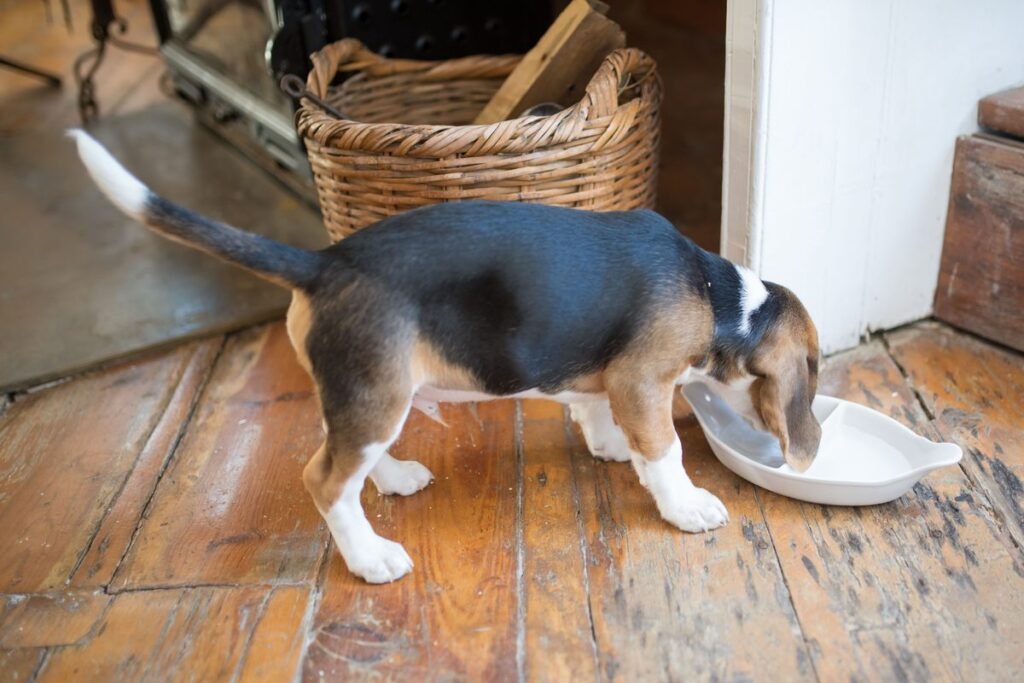
A puppy feeding schedule calculator by age works out how much to feed a puppy from its age and weight, in three steps: daily calories, cups per day from the food's energy figure, and meals per day. A 14 week old puppy weighing 25 lb and expected to reach 70 lb as an adult needs about 1,627 kcal a day on one rival's worked example, which is about 3.7 cups of a 400 kcal per cup food, split into 3 meals. That example comes from Dexo Calc, and it shows the method clearly, but the amounts are estimates, not prescriptions. Every puppy differs, and the food bag, the puppy's body condition and your vet matter more than any calculator output.
Puppy feeding schedule calculator by age: how the calculation works
A feeding calculator asks for four inputs. First, the puppy's age in weeks or months, because energy needs and meal frequency both change with age. Second, the puppy's current weight in kilograms or pounds, because calories are calculated from weight. Third, the expected adult weight, because a puppy that will grow to 70 lb needs more food at 14 weeks than a puppy that will grow to 10 lb, even at the same current weight. Fourth, the food's energy figure in kcal per cup, from the bag, because cups are not a fixed unit. A cup of one food can hold 330 kcal and a cup of another can hold 500 kcal, and the same puppy needs fewer cups of the denser food.
The calculation then runs in three stages. Stage 1 is resting energy requirement, known as RER. Stage 2 multiplies RER by a growth factor to give daily calories. Stage 3 divides daily calories by the food's kcal per cup to give cups per day, then divides cups per day by meals per day to give cups per meal. Each stage has a formula and a caveat, and this article gives both, because a calculator that hides its formula cannot be checked.
The RER formula used by the rival calculators is RER equals 70 times body weight in kilograms to the power 0.75. That formula is attributed to Merck and to the AAHA 2021 nutrition guidance by Dexo Calc, Wag Years, Paw Charts and Pet Cro, consistently across four rivals, but the Merck page itself was not opened in this session. This article therefore labels the formula as the standard veterinary formula as reported by those sources, not as a directly verified Merck quote. Do not present it as a Merck quote until the Merck page is opened.
The growth multiplier is where the rivals agree and also where they oversimplify. The standard version is 3 times RER for puppies under 4 months, and 2 times RER after 4 months. That step, from 3 to 2 at 4 months, is a cliff the pages do not smooth, and Wag Years notes that individual dogs vary by plus or minus 30 percent around the result. A puppy at 3 months and 29 days gets 3 times RER, and the same puppy a day later gets 2 times RER, which is a drop of a third overnight. Real puppies do not drop their energy needs by a third overnight. Treat the multiplier as a planning band, taper it gradually around 4 months, and watch the puppy's body condition, not just the calculator.
The NRC growth equation is a second method, used by Dexo Calc. It calculates kcal per day as 130 times weight in kilograms to the power 0.75, times 3.2, times the exponential of minus 0.87 times p minus 0.1, where p is current weight divided by expected adult weight. The equation comes from the National Research Council 2006, a peer reviewed origin, but Dexo Calc itself notes that it can overestimate the needs of pet puppies. Present it with that caveat, as this article does. The worked example below uses the NRC equation for the Dexo Calc puppy, because that is the example the rival gives, and the RER method for a second puppy, so the reader can see that two methods give different answers from the same puppy.
Worked examples: two puppies, two methods
First, the Dexo Calc example. A 14 week old puppy weighing 25 lb, expected to reach 70 lb as an adult, needs about 1,627 kcal a day on the NRC growth equation, about 3.7 cups of a 400 kcal per cup food, split into 3 meals. That is about 1.2 cups per meal. The arithmetic is 1,627 divided by 400 equals 4.07 cups, but Dexo Calc gives 3.7 cups, which suggests a different kcal per cup or a rounding in the rival example. This article reports the rival's figures as the rival gives them, and it flags the arithmetic gap rather than smoothing it over. If you run the same puppy through the RER method, the answer will differ again, and that difference is the point: feeding calculators give a band, not a single true number.
Second, a smaller puppy on the RER method, so the reader can check the arithmetic. Take a puppy weighing 5 kilograms. RER equals 70 times 5 to the power 0.75. Five to the power 0.75 is about 3.34, so RER is about 234 kcal a day. At under 4 months, multiply by 3, which gives about 702 kcal a day. At 400 kcal per cup, that is about 1.8 cups a day. Split into 4 meals, that is about 0.45 cups per meal. At over 4 months, multiply by 2 instead, which gives about 468 kcal a day, about 1.2 cups a day, split into 3 meals at about 0.4 cups per meal. Those are planning figures, not prescriptions. If the puppy is thin, feed more and ask the vet. If the puppy is fat, feed less and ask the vet. The scale and the ribs tell you more than the calculator does.
Body condition is the check that matters most, and it is the check no calculator can do. Feel the ribs: you should feel them easily under a thin layer of fat, without pressing hard, and you should see a waist from above and a tuck from the side. If you cannot feel the ribs, the puppy is getting too much food, whatever the calculator says. If the ribs are prominent and the puppy is always hungry, the puppy may need more, and the vet should check that first. Pet Cro suggests adjusting by plus or minus 10 percent by body condition, but that adjustment rule is unattributed, so this article gives it as a rival suggestion, not as a veterinary rule. Adjust in small steps, watch for a week, and reweigh.
Meals per day by age: the VCA schedule
Meal frequency is the part of the feeding schedule with the clearest veterinary source, and this article follows VCA Canada, whose caring from birth to weaning guide was opened and read in full. The VCA schedule is: completely weaned at about 8 to 10 weeks, about 4 meals daily; by 3 months, reduce to 3 meals a day; most breeds progress to 2 meals a day by 4 to 6 months; slow maturing giant breeds may need more frequent feeding until nearly 2 years old.
| Age | Meals per day, VCA Canada |
|---|---|
| Weaning, 3 to 8 weeks | 4 to 6 small meals a day during gruel, then about 4 meals daily when fully weaned at 8 to 10 weeks |
| 8 to 12 weeks | About 4 meals a day |
| 3 months | Reduce to 3 meals a day |
| 4 to 6 months | Most breeds progress to 2 meals a day |
| Giant breeds | May need more frequent feeding until nearly 2 years old |
Rival pages give a similar schedule, attributed to the AKC, but with differences worth naming. Wag Years gives 6 to 12 weeks 4 a day, 3 to 6 months 4 dropping to 3, 6 to 12 months 2 a day, over 12 months 2 a day, attributed to AKC Puppy Feeding Fundamentals. Pet Cro gives 4 at 8 to 12 weeks, 3 at 3 to 6 months, 2 from 6 months, also attributed to AKC. Paw Charts notes a disagreement between two Merck editions: the clinical edition gives 3 meals a day from weaning to 6 months, with no 4 meal stage, while the pet owner edition gives 4 meals from 6 weeks. Paw Charts chooses the pet owner schedule as a preference, not as a verified rule, and it notes a useful correction that most rivals miss: the schedule starts at 6 weeks, not 8 weeks.
The AKC meal schedule was not opened in this session, so the AKC figures in this article are labelled as attributed to AKC by Wag Years and Pet Cro, not as directly verified. The VCA schedule is the verified anchor, because the VCA page was opened and read in full. If your vet gives a different frequency for your puppy, follow the vet. A giant breed puppy that needs 3 meals at 8 months is not behind. It is a giant breed puppy, and the VCA schedule says so.
Cups per day: why the bag matters more than the chart
No authoritative source gives a cups per day figure for a named brand, or a fixed cups by age table, and this article does not invent one. All cup figures depend on the food's kcal per cup, and rivals agree on that point: the range is about 330 to 500 kcal per cup across foods. A puppy that needs 700 kcal a day needs about 2.1 cups of a 330 kcal per cup food, and about 1.4 cups of a 500 kcal per cup food. The same puppy, the same day, a difference of 0.7 cups, because the food differs. A chart that says a 3 month old puppy needs 2 cups a day, without naming the food, is meaningless.
Read the kcal per cup figure from your own bag, or from the manufacturer's website for that exact food, and enter it in the calculator. If the bag gives kcal per kilogram instead, ask the manufacturer for the kcal per cup, or weigh the food in grams and use the kcal per gram figure. Do not guess the energy figure from a rival chart. Do not use a cup figure from a different brand. And do not feed by volume alone if the puppy's body condition is drifting: reweigh the puppy, recheck the food, and ask the vet whether the amount or the food needs to change.
Treats count too, and they are the most common reason a feeding plan drifts. A puppy that gets treats through the day is eating more than the calculator's cups per day, and the extra calories show up as weight gain that the calculator did not predict. Count treats in the daily total, keep them small, and use the puppy's own kibble as training treats where you can. If you are unsure how much of the daily calories treats should be, ask your vet rather than using a percentage from a rival page, because no verified figure for treats as a share of daily calories is given in the research for this article.
When to switch to adult food
Puppies do not switch to adult food on a birthday. They switch when they have finished most of their growth, and that age depends on size. Dexo Calc gives adult size timing as small 6 to 8 months, medium 9 to 12 months, large 12 to 18 months and giant up to 24 months, attributed to VCA without a page reference. That timing is consistent with the growth finish ages in Puppy Growth Calculator by Age, which gives toy 9 to 12 months, small 10 to 12 months, medium 12 to 15 months, large 15 to 18 months and giant 18 to 24 months, but the Dexo Calc timing is not directly verified against a VCA page in this session, so it is labelled as attributed.
The practical rule is to ask your vet at the 6 month visit, and again at 12 months, whether the puppy is ready to switch. A small breed puppy may be ready at 9 months. A giant breed puppy may still need puppy food at 18 months. Switching too early can slow growth. Switching too late can add weight that a growing skeleton does not need. The calculator can tell you the adult weight to plan for, but it cannot tell you the day to switch foods. That is a vet decision, based on the puppy's growth, body condition and breed.
Large breed puppy food deserves a note, because it is a common question and a common confusion. Large breed puppy foods are formulated with controlled energy and calcium for large and giant puppies, whose growth is slower and whose skeletons are more vulnerable to overnutrition. If your puppy is a large or giant breed, ask your vet whether a large breed puppy food is right, rather than feeding a general puppy food and hoping the amounts work out. This article does not recommend a brand or a product, and it does not give a calcium figure, because no calcium amount is verified in the research for this theme.
Feeding the mother through weaning
A feeding schedule for puppies sits beside a feeding schedule for the mother, and the two are linked. Peak milk production is around 3 to 5 weeks after birth, and the mother may eat up to 4 times her normal maintenance ration, divided into 4 meals a day, according to VCA Canada. On the feeding schedule question, as the puppies eat more solid food, her milk demand falls, and her food should be tapered back toward her normal ration. Never cut her food sharply on the day the puppies start gruel. Taper it as their solid intake rises, and ask your vet for the taper for a large litter, where demand stays high longer.
The mother's food in late pregnancy also matters for the puppies' start. Late pregnancy food increase is about 25 to 60 percent by late pregnancy from about week 5, with the AKC giving 35 to 50 percent in its guidance. That increase is for the mother, not for the puppies, and it is included here because a feeding schedule that starts at weaning and ignores the mother's late pregnancy feeding misses the weeks when the puppies' birth weights are set. A mother that is underfed in late pregnancy will have smaller puppies, and no feeding schedule after birth can fully make up for that start. For the mother's feeding in pregnancy, ask your vet for the plan for that dog, rather than using a percentage from a rival page as a prescription.
What rivals get wrong about puppy feeding
Rival feeding calculators are useful, but each has a gap. Dexo Calc gives the NRC equation and a worked example, but it admits the equation can overestimate pet puppies' needs, and its adult size timing is attributed to VCA without a page reference. A reader who takes the 1,627 kcal figure as exact will overfeed a pet puppy that is less active than the equation assumes.
Wag Years shows the arithmetic and gives a meal schedule table attributed to AKC, but the step from 3 times RER to 2 times RER is a cliff the page does not smooth, and it notes individual variation of plus or minus 30 percent without showing how to use that range. A reader who follows the cliff will cut food by a third overnight at 4 months, which is not how real puppies' needs change.
Paw Charts notes the disagreement between two Merck editions on meal frequency, which is genuinely useful, but its own choice of the pet owner schedule is presented as a preference, not a verified rule. Pet Cro gives the Merck 3 times RER up to 4 months then 2 times RER, and meals of 4 at 8 to 12 weeks, 3 at 3 to 6 months and 2 from 6 months, but its plus or minus 10 percent body condition adjustment is unattributed. Dog Chart gives a feeding chart by breed, weight and age with a calculator built with the help of a vet, but it names no vet and shows no formula, which makes it the weakest sourcing in the set. Use the rival calculators to see the method, then check the result against body condition and your vet, rather than trusting any single output.
How to use the schedule week by week
Use the calculator at weaning, at 12 weeks, at 4 months and at 6 months, and reweigh the puppy each time. At each check, record the age, the weight, the food, the kcal per cup, the cups per day and the meals per day, and the body condition score your vet gives. If the puppy is gaining steadily, tracking along a centile and holding a healthy body condition, the schedule is working, even if the calculator output differs from a rival tool by 10 percent. If the puppy is gaining too fast, or too slowly, or crossing centiles sharply, the schedule needs a vet review, not a bigger or smaller cup from a web page.
Do not change the food and the amount at the same time. If you switch foods, keep the calories the same for a week, so you can tell whether a change in weight or stools is from the food or from the amount. If you change the amount, keep the food the same. Changing both at once leaves you guessing which change caused the effect. That is a practical rule, not a veterinary formula, and it is the rule that makes a feeding log useful.
For the weaning dates that start this schedule, read Puppy Weaning Calculator. For the first solid food steps, read When to Start Puppies on Solid Food. For the newborn weight check that comes before feeding starts, read Puppy Weight Gain Calculator.
Questions to ask your vet
Take the feeding schedule and the weight log to the vet and ask four questions. First, what daily calories does the vet expect for this puppy at this age and weight, and does that match the RER or NRC figure, or differ from it? Second, how many meals a day should this puppy have now, and when should the next reduction happen, given its size and breed? Third, what body condition should you aim for, and how should you adjust the amount if the puppy drifts above or below it? Fourth, when should this puppy switch to adult food, and should it be a large breed puppy food in the meantime? Write the answers on the schedule, so anyone feeding the puppy follows the vet's plan.
A calculator gives an estimate only. It never diagnoses a puppy and never takes the place of your vet. The point of a feeding schedule is to plan well and to know when to ask. To check the date that goes with this puppy, use the dog due date calculator and enter the ovulation date if you have it, so the birth date and the feeding schedule sit on the same clock.
Frequently asked questions
How much should I feed my puppy?
It depends on age, current weight, expected adult weight and the food's energy figure. A 14 week old puppy weighing 25 lb and expected to reach 70 lb needs about 1,627 kcal a day on the NRC equation in one rival example, about 3.7 cups of a 400 kcal per cup food, split into 3 meals. Use a calculator for your puppy's numbers, then check body condition and ask your vet.
How many times a day should a puppy eat?
About 4 meals a day at 8 to 12 weeks, 3 meals a day by 3 months, and 2 meals a day by 4 to 6 months for most breeds, according to VCA Canada. During weaning, 4 to 6 small meals a day. On the feeding schedule question, slow maturing giant breeds may need more frequent feeding until nearly 2 years old.
When should a puppy switch to adult food?
When it has finished most of its growth, which depends on size: small breeds at about 6 to 12 months, medium breeds at 9 to 15 months, large breeds at 12 to 18 months and giant breeds up to 24 months. Ask your vet at the 6 month and 12 month visits whether your puppy is ready.
How much to feed a puppy by weight?
Use the RER formula as reported by rival calculators: RER equals 70 times weight in kilograms to the power 0.75, times 3 for puppies under 4 months and times 2 after 4 months. A 5 kilogram puppy has an RER of about 234 kcal a day, so about 702 kcal a day under 4 months and about 468 kcal a day after. Those are planning figures, not prescriptions.
How many cups of food should a puppy eat a day?
It depends on the food's kcal per cup. Divide daily calories by kcal per cup. A puppy needing 700 kcal a day needs about 2.1 cups of a 330 kcal per cup food and about 1.4 cups of a 500 kcal per cup food. Read the kcal per cup figure from your own bag.
How do I know if I am feeding my puppy the right amount?
Feel the ribs, look for a waist from above and a tuck from the side, and weigh the puppy regularly. If the ribs are easy to feel under a thin layer of fat and the puppy is gaining steadily along a centile, the amount is about right. If the ribs are hard to feel or very prominent, ask your vet to review the amount.
Sources
- VCA Canada, "Breeding for Dog Owners: Caring from Birth to Weaning." https://vcacanada.com/know-your-pet/breeding-for-dog-owners-caring-from-birth-to-weaning — Completely weaned at about 8 to 10 weeks, about 4 meals daily; by 3 months reduce to 3 meals a day; most breeds progress to 2 meals a day by 4 to 6 months; slow maturing giant breeds may need more frequent feeding until nearly 2 years old; peak milk production about 3 to 5 weeks after birth, mother may eat up to 4 times her normal maintenance ration, divided into 4 meals a day. Opened and read in full.
- Dexo Calc, "Puppy Food Calculator." https://www.dexocalc.com/pet-calculators/puppy-food-calculator/ — NRC growth equation, worked example 14 week old 25 lb puppy expected to reach 70 lb needing about 1,627 kcal a day, about 3.7 cups of a 400 kcal per cup food, 3 meals; NRC equation can overestimate pet puppies; analysis from search excerpts in the research file.
- Wag Years, "Puppy Feeding Calculator." https://www.wagyears.com/tools/puppy-feeding-calculator — RER equals 70 times kg to the power 0.75, puppies 3 times RER under 4 months and 2 times RER after; meal schedule attributed to AKC; individual variation plus or minus 30 percent; analysis from search excerpts in the research file.
- Paw Charts, "Dog Food Calculator." https://www.paw-charts.com/dog-food-calculator/ — Disagreement between two Merck editions on meal frequency; analysis from search excerpts in the research file.
- Pet Cro, "How Much to Feed a Puppy." https://www.petcro.com/blog/how-much-to-feed-a-puppy — Merck 3 times RER up to 4 months then 2 times; meals 4 at 8 to 12 weeks, 3 at 3 to 6 months, 2 from 6 months; analysis from search excerpts in the research file.
- Kim and Wakshlag 2023, peer reviewed, via the programme verified source record — Energy requirement in the first 4 weeks of life around 15 to 20 kcal per 100 g body weight, a reference figure not a feeding prescription.
Disclaimer
This article is general information only. It cannot tell you how much to feed a puppy, diagnose any condition, or stand in for veterinary advice. Calculator results on this site are estimates. If you are worried about a puppy's weight, growth or feeding, or if anything in this guide worries you, speak to your veterinarian.
Keep reading

My Dog Is Pregnant: What Do I Do Now
Your dog is pregnant and it was not planned. Start here: confirm it, book the vet, work out the due date, and…

Dog Pregnancy Preparation Guide Before Due Date
Get ready before the due date in three waves: the vet plan and puppy count, the room and whelping box, and the…

How to Care for a Pregnant Dog for the First Time
Your dog is pregnant for the first time, and you have never done this before. Start with confirmation and a vet plan,…