Dog Due Date Changed After Ultrasound: Which Date Is Right?
A dog due date changed after ultrasound is usually not a mistake. It is two different dating methods giving two different answers, and the scan is not necessarily the better one. An ultrasound estimates gestational age from the size and development of the puppies, and it cannot predict the whelping date precisely. A progesterone timed ovulation date is a tighter clock than a scan estimate, and a mating date is a looser one. The question is not which date is right in the abstract. It is which method produced each date, and where each method sits in the hierarchy. This article gives that hierarchy, explains why scans shift dates, and tells you which date to plan around.
Dog due date changed after ultrasound: which date is right?
The short answer is that the progesterone or LH timed date is the one to trust first, the scan estimate comes second, and the mating date comes last. If your vet timed ovulation with progesterone testing, that date outranks the scan. If the scan is the only new information and it disagrees with a mating counted date by a few days, the scan is the better of the two, but only by a few days, and the honest answer is still a window, not a single day. Or the scan finds no puppies at all, that is not a dating disagreement if the scan and the mating date disagree by more than a week. That is a reason to ask the vet directly.
The reason the hierarchy runs that way is the biology. Gestation from ovulation is about 62 to 64 days, an average of about 63 days, for all breeds, and with a known ovulation date the due date is predictable to within about one to two days, according to Cornell. A scan does not measure ovulation. It measures the puppies as they are on the day of the scan, and it compares their size and development with what is typical for that stage. Puppies vary in size, litters vary in number, and a small litter of large puppies can look older than it is, while a large litter of small puppies can look younger. The scan estimate therefore carries an error of days, and the error grows as the pregnancy goes on. The ovulation date carries an error of a day or two. That is why the ovulation date wins.
What an ultrasound can and cannot do
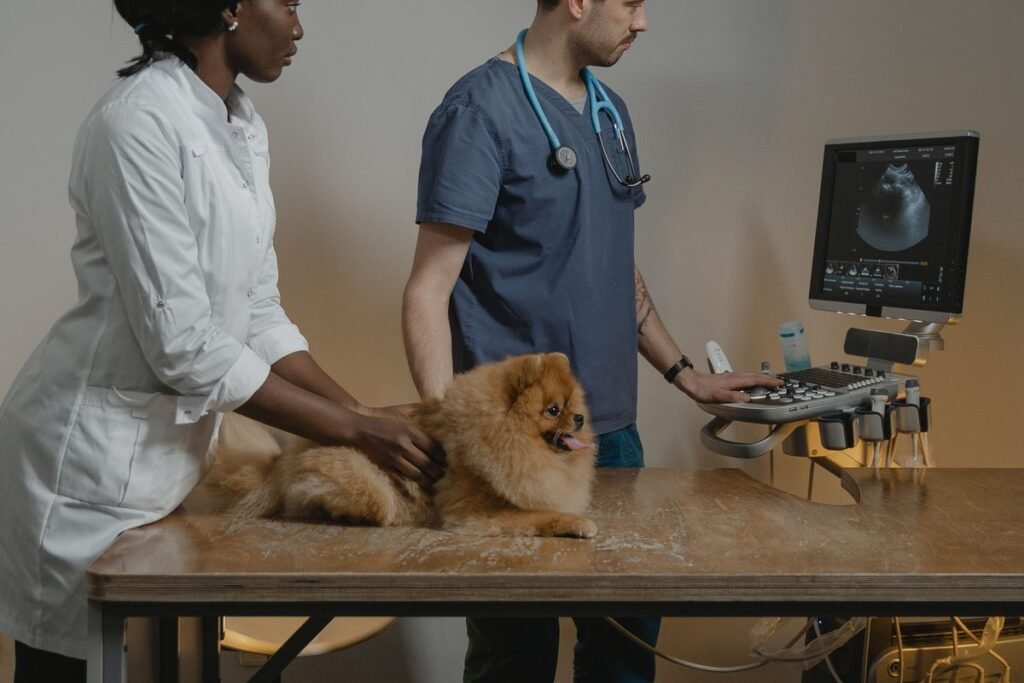
An ultrasound is a very good tool for some questions and a poor tool for others, and the confusion starts when owners ask it the wrong question. What it does well is confirm a pregnancy, show whether the puppies are alive, and give a rough sense of stage. It reliably detects pregnancy from about 25 to 35 days, most reliably after day 28, and it confirms viability by showing the puppies' heartbeats, which are visible from about day 25 onward. If the question is whether she is pregnant, and whether the puppies are alive, an ultrasound is the right tool, and it is the tool to ask for.
What it does not do well is count the puppies, and it does not give a precise whelping date. The count is unreliable because puppies can hide behind each other, and a scan that counts four puppies may be missing a fifth. The date is imprecise because it is an estimate of gestational age from size, not a measurement of when ovulation happened. One calculator site, CanineCalc, puts it plainly: ultrasound cannot predict the whelping date precisely. That is consistent with the authoritative sources, and it is the point this article is built on. A scan that moves your due date by three days has not found an error in your mating date. It has given you a second estimate with its own error, and the two estimates overlap.
There is one more limit worth knowing. A scan done too early can give false reassurance in either direction. A scan before day 25 may miss a pregnancy that is there, and a scan done very early may also be read as a stage it is not. The research file notes that one calculator site recommends scanning from day 25 to 30, and day 28 to 32 if the dates are unsure, because earlier scans are less clear. If your scan was done before day 25 and it changed the date, ask whether a repeat scan at day 28 or later would give a clearer picture before you change your plans.
The dating hierarchy, from best to weakest
The hierarchy below is built from the verified anchors, not from any rival page, because no rival article exists on the exact question of a date that changed after a scan. Each anchor is a way of counting one pregnancy, and the windows show why the hierarchy runs the way it does.
| Rank | Dating method | Window | Why it ranks here |
|---|---|---|---|
| 1 | Progesterone timed ovulation, or LH surge | Ovulation 62 to 64 days; LH surge 64 to 66 days | The tightest clock. Cornell gives 63 days plus or minus 1 to 2 days from a known ovulation date. |
| 2 | First day of diestrus, from vaginal cytology | 56 to 58 days from the first day of diestrus | A measured biological event, but harder to pin down than ovulation, and the window is wider. |
| 3 | Ultrasound estimate of gestational age | An estimate, not a window | Measures puppy size and development, which vary. Good for confirming pregnancy and viability, poor for a precise date. |
| 4 | Mating date | 58 to 72 days from the first mating | The weakest clock. Mating, ovulation and fertilisation are days apart, so the window is fourteen days wide. |
Read the hierarchy as a rule for conflicts. When two methods disagree, the higher ranked one wins, unless the disagreement is so large that it suggests something else is wrong. A progesterone timed date that disagrees with a scan by three days is a normal disagreement, and the progesterone date stands. A scan that disagrees with a mating date by five days is also normal, and the scan is the better of the two, because the mating window is fourteen days wide and the scan error is smaller. A scan that disagrees with a progesterone timed date by ten days is not normal, and it needs a conversation with the vet, because either the timing record is wrong, the scan was misread, or the pregnancy has changed.
One point of care about the top of the hierarchy: a progesterone timed date is only as good as the timing that produced it. A single progesterone value does not date a cycle. Ovulation sits at roughly 4 to 10 ng per mL according to Merck, and 4 to 8 ng per mL according to the AKC, and your vet reads the trend with one lab, not one number. In clinic progesterone kits are also less accurate in the 1.5 to 10 ng per mL range, according to Merck, which is exactly the range that matters. If your ovulation date came from a single reading rather than a series, tell your vet, and treat the hierarchy with that in mind. On the changed ultrasound question, the progesterone due date guide works through reading a series in full.
Why scans shift dates: the five reasons
A scan moves a due date for one of five reasons, and they are worth separating, because the response is different for each.
The first reason is that the scan is an estimate and the mating date is a wide window, so the two were never going to agree exactly. A mating counted date is the middle of a 58 to 72 day window. A scan estimate sits somewhere inside that window, usually a few days either side of the middle. The shift is the difference between two honest estimates, not an error in either one. If the shift is three or four days, this is almost certainly the explanation.
The second reason is puppy size. A small litter of large puppies can look older than it is, and the scan will date the pregnancy later than the mating date suggests, moving the due date earlier. A large litter of small puppies can look younger, moving the due date later. Litter size may shift gestation by about one to two days in reality, but the scan estimate can move by more than that, because size is only a rough guide to age. A single puppy is the hardest case for a scan to date, because there is only one puppy to measure and no litter mates to compare it with. The singleton puppy guide covers the single puppy case in full.
The third reason is that the scan was done at a stage where dating is less reliable. Early scans, before day 28, are less clear, and late scans, when the puppies are large and crowded, are harder to measure. The most useful scan for dating is in the middle of pregnancy, when the puppies are big enough to measure and small enough to see clearly. If the scan that moved your date was very early or very late, ask whether a repeat scan would help.
The fourth reason is that the pregnancy has changed since the mating. Puppies can be reabsorbed early in pregnancy without visible signs, and a later scan finding fewer puppies than an earlier scan, or none at all, is not the same as a wrong first scan. It is a changed pregnancy. A positive relaxin test followed by a negative one can also indicate a pregnancy that was lost, according to the VCA. If the scan finds no puppies where an earlier test or scan found some, that is a vet conversation, not a recalculation.
The fifth reason is that the mating date was wrong. A mating the owner did not see, a slip mating, a second mating that was not recorded, or a silent heat that hid the real breeding date can all put the true conception days away from the recorded date. In that case the scan is not wrong. The mating record is, and the scan is the first sign of it. The wrong date guide works through that recheck step by step.
The worked example: mating 20 November 2026
Take a real example and run the hierarchy on it. A dog is mated once, on Friday 20 November 2026, with no progesterone timing. The mating counted window is 58 to 72 days from 20 November. Day 58 is Sunday 17 January 2027. Day 63, the middle date most calculators print, is Friday 22 January 2027. Day 72 is Sunday 31 January 2027. On the changed ultrasound question, all of those dates were verified with the date command.
Now suppose the vet scans her on Tuesday 15 December 2026, which is day 25 from the mating, and says the puppies look a few days older than the mating date suggests, moving the due date to Monday 18 January 2027. Is the scan right and the mating date wrong? Neither, quite. The scan estimate sits inside the mating window, four days before the middle date, and that is a normal disagreement between two methods with different errors. The honest answer is still the window, Sunday 17 January to Sunday 31 January 2027, with the scan suggesting the early part of it is more likely. The owner should have the whelping area ready by the early edge, Sunday 17 January, and should not treat Monday 18 January as a promise any more than Friday 22 January was.
Now change one fact. Suppose the same dog had progesterone timed ovulation on Monday 23 November 2026, three days after the mating. Her ovulation timed window is 62 to 64 days from ovulation: Sunday 24 January to Tuesday 26 January 2027, with the central date Monday 25 January 2027. The scan that says Monday 18 January now disagrees with the progesterone date by a week, and that is not a normal disagreement. The progesterone date outranks the scan, and the owner should ask the vet why the scan reads a week early, whether the scan was done too early to date reliably, or whether the litter is small and the puppies are large. The scan does not replace the progesterone date. It prompts a question about it.
And suppose the scan finds no puppies at all. That is not a dating disagreement. That is a different question, and the answer is a relaxin test, with the retest rule, or a repeat scan, not a new due date. The negative test guide works through the retest protocol, and the signs but not pregnant guide works through the case where the signs say pregnant and the tests say otherwise.
When a scan says something else entirely
There are three scan results that are not dating questions at all, and they need a vet conversation rather than a recalculation. The first is a scan that finds no puppies when a relaxin test was positive. That can mean the pregnancy was lost, or the scan was done too early, and the vet will want to repeat the scan or the blood test. The second is a scan that finds fewer puppies than an earlier scan. That can mean reabsorption, and the vet will want to check whether the remaining puppies are well. The third is a scan that finds puppies but no heartbeats. That is a serious finding, and the vet will want to act on it at once.
In each of those cases, the due date is the least important thing on the table. The health of the mother and the puppies comes first, and the date can be reworked once the vet knows what is happening. Do not keep recalculating while a scan result like that is unresolved. Call the vet, share the mating record and the progesterone record, and let the vet decide what to do next.
What to ask your vet after a scan moves the date
Take the mating record and the progesterone record, if there is one, to the next vet visit, and ask four questions. First, which date did the clinic record as the ovulation date, and which as the LH surge date, and do the two agree? Second, what stage did the scan put the pregnancy at, and how was that stage estimated, from size, from development, or from both? Third, how large is the scan error at this stage, and is a repeat scan likely to narrow it? Fourth, which date should you plan around, and what window should you have the whelping area ready for?
Also ask which vet call threshold applies. On the changed ultrasound question, the AKC threshold is no signs of whelping 64 days after the last mating. The Cornell threshold is one to two days past an ovulation timed due date. If the scan has moved the date, the threshold may have moved with it, and the vet should say which one to use. Use whichever threshold comes first, and do not wait for the latest possible day in the window to run out before calling.
A calculator gives an estimate only. It never diagnoses a pregnancy and never takes the place of your vet. To check the date you have, enter the best date you hold, ovulation first, mating only if that is all you have, in the dog due date calculator and record the full window, not just the central date. The dating from a scan is in Dog Due Date From Ultrasound, the reasons a date moves are in Why Did My Dog's Due Date Change?, and the wrong date guide works through the recheck when the date looks wrong.
Frequently asked questions
Can an ultrasound date be wrong?
Yes, in the sense that it is an estimate, not a measurement of ovulation. An ultrasound estimates gestational age from the size and development of the puppies, and puppies vary in size, so the estimate carries an error of days. A scan that moves your due date by a few days has not necessarily found an error in your mating date. It has given you a second estimate with its own error. A scan that disagrees with a progesterone timed date by more than a week needs a conversation with the vet.
Why did my vet change my dog due date after the ultrasound?
Because the scan estimated a different gestational age from the one your mating date implied. That usually means the puppies look a few days older or younger than the mating date suggests, which is normal, because puppy size varies and the mating window is fourteen days wide. It can also mean the litter is small, the scan was done at a stage where dating is less reliable, or the mating date was wrong. Ask your vet which method the new date came from and how large the scan error is at this stage.
Which is more accurate, ultrasound dating or mating date?
For a due date, the scan estimate is usually better than a mating date, because the mating window is 58 to 72 days, fourteen days wide, while the scan error is smaller. But a progesterone timed ovulation date is better than both, with a window of only 62 to 64 days. The hierarchy is progesterone or LH timing first, then the scan estimate, then the mating date. If you have a progesterone timed date, use it, and treat the scan as supporting evidence, not a replacement.
Can ultrasound predict the whelping date precisely?
No. Ultrasound cannot predict the whelping date precisely. It estimates gestational age, and the due date still depends on mating and ovulation timing. A scan confirms pregnancy and viability, and it gives a rough stage, but it does not set a precise whelping date. Plan around a window, not a single day, and use the vet call thresholds for the best clock you hold.
My ultrasound due date is a week different from my mating date. Which do I trust?
If the difference is a week and you have no progesterone timing, the scan is the better of the two, because the mating window is fourteen days wide and a week is inside it. Plan around the window, with the whelping area ready by the early edge, and ask your vet whether a repeat scan would narrow the estimate. If you do have a progesterone timed ovulation date, trust that over the scan, and ask your vet why the scan reads a week different.
Can an ultrasound tell how many puppies there are?
Not reliably. An ultrasound confirms pregnancy and shows heartbeats, but it does not give a reliable puppy count, because puppies can hide behind each other. The reliable count comes from an X-ray, with skeletons visible from about day 43 to 45 and the count best from day 55 onward. If you need a count to plan the whelping, ask about an X-ray at the right stage rather than pressing the ultrasound for a number it cannot give.
Sources
- American Kennel Club, "Dog Pregnancy: Signs, Care, and Preparing for Puppies." https://www.akc.org/expert-advice/health/dog-pregnancy-care-prep/ — Gestation about 62 to 64 days; no signs of whelping 64 days after the last mating is a reason to call the vet; ultrasound 25 to 35 days; relaxin 25 to 30 days; X-ray best at 55 days or more.
- Cornell University College of Veterinary Medicine, Riney Canine Health Center, "The normal whelping process." https://www.vet.cornell.edu/departments-centers-and-institutes/riney-canine-health-center/canine-health-topics/normal-whelping-process — Average 63 days from ovulation; 63 plus or minus 1 to 2 days from a known ovulation date; 63 plus or minus 7 days from the first breeding; call the vet one to two days past an ovulation timed due date.
- Merck Veterinary Manual, Dog Owners, "Management of Reproduction in Dogs." https://www.merckvetmanual.com/dog-owners/reproductive-disorders-of-dogs/management-of-reproduction-in-dogs?query=reproductive — Pregnancy about 62 to 64 days; breeding date does not always match conception.
- Merck Veterinary Manual, "Approximate Gestation Periods." https://www.merckvetmanual.com/multimedia/table/approximate-gestation-periods — Gestation from first mating 58 to 72 days.
- Merck Veterinary Manual, "Serologic Test Kits." https://www.merckvetmanual.com/clinical-pathology-and-procedures/diagnostic-procedures-for-the-private-practice-laboratory/serologic-test-kits — Ovulation 2 days after the LH surge; parturition day 64 to 66 after the surge; progesterone 4 to 10 ng per mL on the day of ovulation; in clinic kits less accurate in the 1.5 to 10 ng per mL range.
- UC Davis School of Veterinary Medicine, "Normal Whelping in the Bitch." https://healthtopics.sf.ucdavis.edu/sites/g/files/dgvnsk6721/files/inline-files/cenormalwhelp.pdf — 64 to 66 days from the LH surge; 58 to 72 days from first mating.
- VCA Hospitals, "Pregnancy Testing in the Dog." https://vcahospitals.com/know-your-pet/pregnancy-testing-in-the-dog — Ultrasound reliably 25 to 35 days, most reliable after day 28; confirms pregnancy and viability but not count; relaxin 22 to 27 days after breeding; a positive then negative relaxin can indicate pregnancy loss; X-ray skeletons visible about day 43 to 45, best count day 55 or later.
- CanineCalc, "Dog Pregnancy Ultrasound Cost + When to Scan (2026)." https://caninecalc.com/dog-pregnancy-ultrasound-cost/ — Opened in full in the research pass. Scan from day 25 to 30, day 28 to 32 if dates unsure; what a scan shows and cannot do, including that it cannot predict the whelping date precisely and cannot give a firm puppy count; ultrasound vs X-ray split. Its cost guide of 250 to 500 US dollars is a single site figure, not verified, and is not used in this article.
Where sources disagree, the disagreement is stated in the article rather than picking one figure silently: Cornell gives the mating count as 63 plus or minus 7 days (56 to 70) while Merck and UC Davis give 58 to 72 days from first mating. This article uses the Merck and UC Davis 58 to 72 day range for mating counted dates. One calculator page gives "about 65 days from egg release" and "61 days from eggs becoming fertile", which conflicts with the verified 62 to 64 days from ovulation; those figures are not used. No rival article exists on the exact query "due date changed after ultrasound"; the dating hierarchy in this article is built from the verified anchors, not from a rival.
Disclaimer
This article is general information only. It cannot tell you whether a dog is pregnant, diagnose any condition, or stand in for veterinary advice. Calculator results on this site are estimates. If you think your dog may be pregnant, or if anything in this guide worries you, speak to your veterinarian.
Keep reading

My Dog Is Pregnant: What Do I Do Now
Your dog is pregnant and it was not planned. Start here: confirm it, book the vet, work out the due date, and…

Dog Pregnancy Preparation Guide Before Due Date
Get ready before the due date in three waves: the vet plan and puppy count, the room and whelping box, and the…

How to Care for a Pregnant Dog for the First Time
Your dog is pregnant for the first time, and you have never done this before. Start with confirmation and a vet plan,…