Dog Due Date From Ultrasound
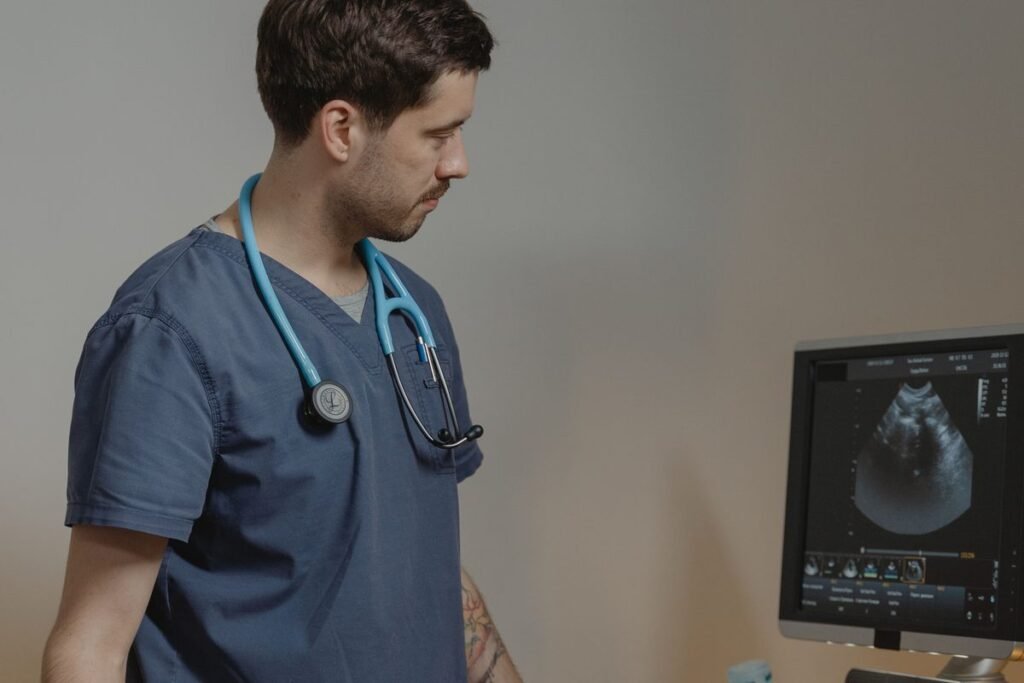
A dog due date from ultrasound is worked out from what the vet measures on the scan. Yes, your vet can estimate a due date from an ultrasound scan, and no, the scan cannot give you an exact due date. The vet measures a structure inside the pregnancy, puts the measurement into a published formula, and the formula returns an estimate of how many days are left before whelping. That estimate comes with a band of about one to two days either side, and the band widens when the litter is very small or very large, when the wrong size formula is used, and when the scan is done very late. If you already have a vet timed ovulation date, the scan does not replace it. If you have no dates at all, the scan is the best dating tool there is, and this article explains how it works, how accurate it is, and how to fit the scan date together with your calculator date.
Dog due date from ultrasound: what the live ultrasound posts do not cover
This site already has two ultrasound posts. Dog Pregnancy Ultrasound explains what a scan shows, and When Can You Do an Ultrasound on a Pregnant Dog? explains when to book one. Neither dates the pregnancy from the scan. This article is the dating method, not the scan guide, and it links to those two posts for booking and what to expect instead of repeating them.
The distinction matters because ultrasound has two different jobs and they are easy to confuse. The first job is confirmation: is she pregnant, and are the puppies alive? Ultrasound reliably detects pregnancy by 25 to 35 days, according to the Merck Veterinary Manual and the AKC, and the AKC adds that it can usually detect fetal heartbeats. The VCA puts it the same way: developing embryos can be detected as early as three weeks after breeding, and most scans performed after day 28 are reliable. The second job is dating: how far along is she, and when will she whelp? That job uses measurements and formulae, and it is what this article covers.
One line from the live ultrasound post has to be kept intact, because this article builds on it rather than contradicting it: ultrasound cannot give an exact due date. What follows explains how the rough estimate is produced, why it is rough, and when it is still the best date you have.
What the vet measures: ICC early, BPD late
The vet does not date a pregnancy by looking at the puppies and guessing. The vet measures one of two structures, depending on how far along the pregnancy is, and the choice of structure is the first thing to understand.
In early pregnancy the vet measures the inner chorionic cavity, known as the ICC. The ICC is the fluid filled cavity that surrounds the early embryo, and it is an extra fetal measurement, meaning it measures something around the fetus rather than the fetus itself. In the first weeks it keeps a round, spherical shape with clearly defined edges, which is what makes it measurable. A 2025 peer reviewed study in the Indian Journal of Animal Research, which measured 62 ICC values in 114 healthy bitches, used ICC measurements taken in the fourth week of gestation, while the cavity still held that spherical form. Once the cavity loses its round shape, ICC stops being useful, and the vet switches to the second measurement.
In later pregnancy the vet measures the biparietal diameter, known as BPD or BP. That is the distance between the two parietal bones of a puppy's skull, measured when the bones lie parallel so the distance can be taken correctly. It is a fetal measurement, a direct measure of the puppy's head, and it grows steadily through the second half of pregnancy, which is why it works late when ICC no longer does. The same 2025 study took 52 BPD measurements from the same 114 bitches and compared the two measurements head to head.
The rule, stated by Luvoni in a 2013 review of ultrasonographic gestation in dogs and cats, is that the ICC during early pregnancy and the biparietal diameter during late pregnancy are the two measurements highly correlated with gestational age, and both are highly reliable for predicting the parturition date when specific formulae for different size bitches are applied. That last condition is load bearing: the formulae are size specific, and using the wrong size formula is one of the ways a scan date goes wrong. The size groups used in the 2025 study follow Beccaglia and Luvoni 2012: small breeds under 10 kg, medium breeds 10 to 25 kg, and large breeds over 25 kg.
The formulae: how a measurement becomes a due date
A measurement on its own is not a date. The vet converts it with a published formula, and there are two published sets in common use. Both are vet tools, explained here so you can understand what your vet did, not so you can do it yourself. Measuring ICC or BPD takes an ultrasound machine, a trained operator, and a view of the right structure at the right angle. Do not try to date a pregnancy from a scan image at home.
The first set is Luvoni and Grioni 2000, which gives days before parturition directly. For the ICC: in small bitches, days before parturition equals the ICC in millimetres minus 68.68, divided by 1.53; in medium and large bitches, the ICC in millimetres minus 82.13, divided by 1.8. For the biparietal diameter: in small bitches, days before parturition equals the BP in millimetres minus 25.11, divided by 0.61; in medium and large bitches, the BP in millimetres minus 29.18, divided by 0.7. Note the two different starting numbers for small and medium dogs: the formula knows the bitch's size, and a formula built for a medium bitch will misdate a small bitch's pregnancy.
The second set is Mattoon and Nyland 2002, which gives gestational age first and then works out the days left. For the ICC: gestational age in days equals 6 times the ICC in centimetres, plus 20. For the biparietal diameter, using the head diameter in centimetres: gestational age equals 15 times the head diameter, plus 20, and days before parturition equals 65 minus the gestational age. The 65 in that last step is the count from the LH surge, which is why the two sets can disagree by a day or two on the same scan: they count from slightly different anchors, and the vet knows which anchor each formula uses.
The worked examples below use the Mattoon and Nyland set, because its two steps make the arithmetic easy to follow. The measurements in them are illustrative, chosen to show how the arithmetic works, not results from a real scan. A real scan result comes with the vet's measurement, the formula used, and the bitch's size group, and all three belong in the record.
Worked example 1: dating from an early scan with ICC
Take a bitch whose LH surge was Wednesday 18 November 2026 and whose ovulation followed on Friday 20 November 2026. She is scanned on Tuesday 15 December 2026, which is 25 days after ovulation and 27 days after the LH surge, inside the reliable ultrasound window of 25 to 35 days. The vet measures the ICC in one of the cavities and records 1.2 centimetres.
Apply the Mattoon and Nyland formula for ICC: gestational age equals 6 times 1.2, plus 20, which is 27.2 days. That is the age counted from the LH surge, and it fits: 27 days have passed since the LH surge on 18 November. Days before parturition equals 65 minus 27.2, which is 37.8 days, rounded to 38 days. Add 38 days to the scan date, Tuesday 15 December 2026, and the estimated due date is Friday 22 January 2027.
Now check it against the ovulation clock, which is the clock the vet timed. Ovulation on Friday 20 November 2026 plus 63 days is Friday 22 January 2027. The scan estimate and the ovulation calculation land on the same day. That agreement is the best outcome a scan can give, and it is also the check that the scan was read right. When the two agree, trust the ovulation date for planning, because its window is three days wide while the scan estimate carries a band of one to two days either side even at its best.
Worked example 2: dating from a later scan with BPD
Take the same bitch, scanned again on Monday 21 December 2026, which is 31 days after ovulation and 33 days after the LH surge. The ICC has lost its round shape by now, so the vet measures the biparietal diameter of one puppy and records 0.9 centimetres.
Apply the Mattoon and Nyland formula for the head diameter: gestational age equals 15 times 0.9, plus 20, which is 33.5 days. That fits the 33 days since the LH surge. Days before parturition equals 65 minus 33.5, which is 31.5 days, rounded to 32 days. Add 32 days to the scan date, Monday 21 December 2026, and the estimated due date is Friday 22 January 2027, the same day as the ICC example and the same day as the ovulation calculation.
Two things in these examples deserve attention. First, the rounding: 37.8 days became 38 and 31.5 days became 32, and that rounding alone can move the estimate by a day, which is why the vet reports a band rather than a single date. Second, the formulae assume the vet measured the right structure, at the right angle, in the right size group. A BPD measured with the skull tilted, or an ICC measured after the cavity has lost its shape, gives a number that the formula turns confidently into a wrong date. The formula cannot detect a bad measurement.
How accurate is ultrasound dating?
The honest answer is that it is accurate to within one to two days in the best cases, and much less accurate in the worst ones, and the difference depends on the formula, the litter size, and the bitch's size. The figures below come from the 2025 peer reviewed study in the Indian Journal of Animal Research, which this article opened and read in full. It compared actual whelping dates with predicted dates in 114 healthy bitches, using both the Luvoni and Grioni formulae and the Mattoon and Nyland formulae, at two levels of accuracy, within one day and within two days.
For ICC measurements, prediction accuracy within two days ranged from 43.5 percent to 100 percent, depending on the subgroup and the formula. For BPD measurements, it ranged from 21.2 percent to 100 percent. Those are wide ranges, and they are the point: there is no single accuracy percentage for ultrasound dating. A scan of a medium bitch with a medium litter, read with the Luvoni and Grioni formula, can be right to within two days every time, while a scan of a very small or very large litter, read with the other formula, can be off by more than two days in most cases.
Two patterns in that study are worth naming. First, the Luvoni and Grioni formulae gave higher prediction accuracy than the Mattoon and Nyland formulae overall, and the difference was statistically significant for ICC at the exact predicted date and for BPD at the exact date and at both accuracy levels. The study's authors emphasise using the Luvoni and Grioni formula for whelping prediction based on ICC and BPD measurements over the alternative, particularly for medium sized breeds. Second, litter size mattered: accuracy was higher for medium litters than for low or high litters, for both ICC and BPD, whichever formula was used. A singleton or a very large litter is harder to date from a scan than a middle sized litter, because the measurement itself is affected by how many puppies are sharing the uterus and how they lie.
What this article does not do is give accuracy by scan week as a set of percentages. The week by week pattern, that accuracy is best in the middle weeks and falls close to term, is reported in the Beccaglia and Luvoni 2012 analysis of 495 bitch ultrasounds, which was read as search result text for this article and not opened in full, so its week by week percentages are not reproduced here as verified figures. The pattern is consistent with the rest of the evidence: early ICC measurements are taken while the cavity is round and measurable, and late BPD measurements are affected by individual variation in growth and by puppies overlapping in the ultrasound image, which Luvoni notes in the 2013 review. If your vet tells you the scan was done early or late and the estimate is therefore wider, that is the vet applying this pattern, and it should be believed.
Why the scan cannot give an exact due date
Four reasons, each small on its own, add up to a band rather than a date. First, the measurement itself has error: a millimetre or two on a BPD measurement moves the formula output by several days, because the formula divides by 0.61 or 0.7, so a small measuring error becomes a large date error. Second, puppies grow at slightly different rates, so measuring one puppy gives a slightly different date from measuring another, and the vet's practice is to measure at least two fetuses. Third, the formula is size specific, and a bitch on the border between size groups, or a bitch whose breed has its own published formula, can be misdated by a generic formula. The 2025 study notes that breed specific formulae have been developed for some breeds, and that the non specific Luvoni and Grioni formulae for medium bitches gave results comparable with a German Shepherd specific formula, which is reassuring but not a guarantee for every breed. Fourth, the scan measures where the pregnancy is now, not when it started, so any error in the measurement is an error in the date with nothing to check it against, unless an ovulation or LH date exists to compare it with.
That is the sense in which the live ultrasound post's line holds: ultrasound cannot give an exact due date. It gives a rough estimate, produced by a measurement and a formula, with a band that the vet should state. A scan that returns a single date with no band has hidden the uncertainty instead of removing it, and it should be treated the same way as a calculator that returns a single date from a mating date.
What ultrasound cannot do
Two limits matter for owners. First, ultrasound does not give a reliable puppy count. The VCA states this directly: it can be difficult to count the number of fetuses on ultrasound accurately. The AKC says a scan can give an estimate of litter size, which is not the same as a count. The reliable count comes from an X-ray, with skeletons visible after about day 45 and the best count after day 55, according to the Merck Veterinary Manual and the AKC. See Dog Pregnancy X-Ray for the X-ray timing. A rival claim that ultrasound around day 28 to 30 gives a rough count overstates what the scan can do, and it should not be used to decide when whelping is finished.
Second, ultrasound cannot date a pregnancy from a single still image or a single number handed to the owner. The measurement has to be taken by the vet during the scan, with the right structure in view, and the formula has to match the bitch's size. If a breeder or a forum tells you to plug a number from a scan photo into a formula, that is not dating. It is arithmetic on a number nobody verified.
Fitting the scan date together with the calculator date
Most owners who reach this article have two dates that do not match: a calculator date from a mating or insemination date, and a vet's scan estimate. Here is how to fit them together.
If you have a vet timed ovulation date or LH surge date as well as a scan, trust the ovulation or LH date. The ovulation window is 62 to 64 days, three days wide, and Cornell describes it as predictable to within about one to two days. The scan estimate is a check on it, not a replacement for it. In the worked examples above the two agreed on Friday 22 January 2027, and that agreement is the ideal. If they disagree by a day or two, the disagreement is inside the scan's own band, and the ovulation date still wins. If they disagree by more than a few days, one of the dates is probably wrong, and that is a question for the vet, not for the calculator.
If you have only a mating date and a scan, trust the scan over the mating date. The mating date gives a fifteen day window, 58 to 72 days from the first mating, per the Merck Veterinary Manual and UC Davis. The scan gives an estimate with a band of about one to two days either side in the best cases. The scan is the tighter measurement, and it should move your planning window to the scan's estimate, with the mating window kept as a backup. Do not average the two dates: averaging a fifteen day window and a scan estimate invents a date that neither method supports.
If you have no dates at all, the scan is the dating method. That case is covered in full in the no mating date guide, which explains how the vet stages a pregnancy with no owner known date and how to plan a window from the vet's estimate. The scan section there links here for the method rather than repeating it.
One rule applies in every case: do not move the vet call threshold to the later date. The AKC threshold is no signs of whelping 64 days after the last mating, and Cornell's is one to two days past an ovulation timed due date. A scan estimate that falls later than the ovulation date does not move either threshold later. Take whichever threshold comes first, and ask your vet which clock they are working from. The comparison with the vet's date in general, including the trust hierarchy across all methods, is in the calculator vs vet guide. The all breeds gestation figure behind the scan bands is in How Long Are Dogs Pregnant?.
What to ask your vet after a scan
Take the scan report home and keep it with the breeding record. Ask which measurement was taken, ICC or BPD, and why that one was chosen at that stage. Ask which formula was used and whether it was the size specific version for your dog. Ask for the estimate as a window, not a single date, and ask how wide the band is for this scan. Ask how many fetuses were measured. Ask whether the scan estimate agrees with the ovulation or LH date, if one exists, and if it does not, ask which date the vet wants you to plan around. And ask when the next check should happen: a second scan later in pregnancy can narrow the estimate, and a late X-ray after day 55 gives the puppy count that the scan cannot. How vets combine the scan with the rest of the toolkit is set out in How Do Vets Date a Dog Pregnancy.
Treat every calculator result as an estimate. It cannot diagnose pregnancy and cannot replace your vet. A scan is a veterinary measurement, and it is the vet's interpretation of it that dates the pregnancy, not the number on the report. To check a mating date calculation against the scan, enter the mating date in the dog due date calculator and compare the full window with the scan's estimate, not just the central date. Work through the calculation step by step in How to Calculate a Dog's Due Date, and check how far to trust each result in How Accurate Is a Dog Due Date Calculator?.
Frequently asked questions
Can an ultrasound give my dog's exact due date?
No. Ultrasound gives a rough estimate, not an exact date. The vet measures the inner chorionic cavity early in pregnancy or the biparietal diameter later, puts the measurement into a published formula, and the formula returns an estimate of the days left before whelping, with a band of about one to two days either side in the best cases. The scan is most useful when no breeding dates are known, or as a check on a vet timed ovulation date.
How does the vet date a pregnancy from an ultrasound?
The vet measures a structure on the scan and converts the measurement with a formula. Early in pregnancy the measurement is the inner chorionic cavity, the fluid filled cavity around the embryo. Later it is the biparietal diameter, the distance between the two parietal bones of a puppy's skull. The formulae are size specific, with different versions for small, medium and large bitches. The result is an estimate of the days before parturition, which the vet adds to the scan date.
How accurate is ultrasound dating in dogs?
It is accurate to within one to two days in the best cases and much less accurate in the worst ones. In a 2025 peer reviewed study of 114 bitches, accuracy within two days ranged from 43.5 percent to 100 percent for ICC measurements and from 21.2 percent to 100 percent for BPD measurements, depending on the subgroup and the formula used. Accuracy was higher for medium litters than for very small or very large litters, and the Luvoni and Grioni formulae were more accurate than the Mattoon and Nyland formulae.
Which is better for dating, ICC or BPD?
Neither is better in general; each is used at its own stage. ICC is the early measurement, taken while the cavity is round, around the fourth week. BPD is the late measurement, taken once the puppies' skulls can be measured. The 2025 study found both measurements reliable in their own stage, with litter size affecting BPD accuracy more than ICC accuracy.
My scan date and my calculator date disagree. Which do I trust?
If you have a vet timed ovulation or LH surge date, trust that over the scan. If you have only a mating date and a scan, trust the scan, because the mating date gives a fifteen day window and the scan gives an estimate with a band of about one to two days either side. If the two disagree by more than a few days, ask your vet which date to plan around. Do not average the two dates, and do not move the vet call threshold to the later date.
Can ultrasound tell me how many puppies my dog is having?
Not reliably. Ultrasound can give an estimate of litter size and confirm the puppies are alive, but the VCA states that it can be difficult to count the number of fetuses on ultrasound accurately. The reliable count comes from an X-ray, with the best count after day 55 of pregnancy.
Sources
- American Kennel Club, "Dog Pregnancy: Signs, Care, and Preparing for Puppies." https://www.akc.org/expert-advice/health/dog-pregnancy-care-prep/ — Gestation about 62 to 64 days; ultrasound between 25 and 35 days, can usually detect fetal heartbeats; relaxin 25 to 30 days; X-ray best at 55 days or more; no signs of whelping 64 days after the last mating.
- Cornell University College of Veterinary Medicine, Riney Canine Health Center, "The normal whelping process." https://www.vet.cornell.edu/departments-centers-and-institutes/riney-canine-health-center/canine-health-topics/normal-whelping-process — Average 63 days from ovulation; 63 plus or minus 1 to 2 days from a known ovulation date; ultrasound measurements of the puppies around mid pregnancy can estimate the due date; ovulation timing is the most reliable method for predicting parturition.
- Merck Veterinary Manual, Dog Owners, "Management of Reproduction in Dogs." https://www.merckvetmanual.com/dog-owners/reproductive-disorders-of-dogs/management-of-reproduction-in-dogs?query=reproductive — Ultrasonography can reliably detect pregnancy by 25 to 35 days and confirm the fetuses are alive; X-rays after about day 45, best after day 55 for litter size; pregnancy about 62 to 64 days.
- VCA Animal Hospitals, "Pregnancy Testing in the Dog." https://vcahospitals.com/know-your-pet/pregnancy-testing-in-the-dog — Developing embryos detectable as early as three weeks after breeding; most scans after day 28 reliable; difficult to count fetuses on ultrasound accurately; X-rays best for litter numbers.
- Merck Veterinary Manual, "Serologic Test Kits." https://www.merckvetmanual.com/clinical-pathology-and-procedures/diagnostic-procedures-for-the-private-practice-laboratory/serologic-test-kits — Relaxin first detectable day 20 to 25 after fertilisation; only known pregnancy specific hormone in the bitch. Cited via the programme verified source record; the page was opened in this pass and its opening sections read.
- Reddy et al., "Reliability of Two Formulae Employing Foetal and Extra Foetal Parameters in Predicting Whelping Dates." Indian Journal of Animal Research, 2025, 59(8), 1323 to 1328. https://arccjournals.com/journal/indian-journal-of-animal-research/B-5433 — Peer reviewed study, 114 healthy bitches, 62 ICC and 52 BPD measurements; ICC accuracy within two days 43.5 percent to 100 percent, BPD 21.2 percent to 100 percent; Luvoni and Grioni formulae more accurate than Mattoon and Nyland; medium litters more accurate than low or high litters; formulae given in full (ICC gestational age equals 6 times ICC in centimetres plus 20; BPD gestational age equals 15 times head diameter in centimetres plus 20; days before parturition equals 65 minus gestational age; Luvoni and Grioni days before parturition formulae by size).
- Luvoni, "Ultrasonographic study of gestation in dogs and cats." Revista Brasileira de Reprodução Animal, 2013, 37(2), 172 to 173. Cited from the search result text for this review; the full text was not opened in this pass, so its statements are used here only as corroboration of the 2025 study, not as the sole basis for any figure in this article.
Where sources disagree, the disagreement is stated in the article rather than picking one figure silently: the two formula sets (Luvoni and Grioni, Mattoon and Nyland) give slightly different dates from the same measurement, and the 2025 study reports which performed better. Accuracy by scan week percentages from the Beccaglia and Luvoni 2012 analysis were read as search result text only and are not reproduced here, because they were not verified from a source opened in full in this pass.
Disclaimer
This article is general information only. It cannot tell you whether a dog is pregnant, diagnose any condition, or stand in for veterinary advice. Calculator results on this site are estimates. If you think your dog may be pregnant, or if anything in this guide worries you, speak to your veterinarian.
Keep reading

My Dog Is Pregnant: What Do I Do Now
Your dog is pregnant and it was not planned. Start here: confirm it, book the vet, work out the due date, and…

Dog Pregnancy Preparation Guide Before Due Date
Get ready before the due date in three waves: the vet plan and puppy count, the room and whelping box, and the…

How to Care for a Pregnant Dog for the First Time
Your dog is pregnant for the first time, and you have never done this before. Start with confirmation and a vet plan,…