Whelping Box Pig Rails: What They Are and Why Your Box Needs Them
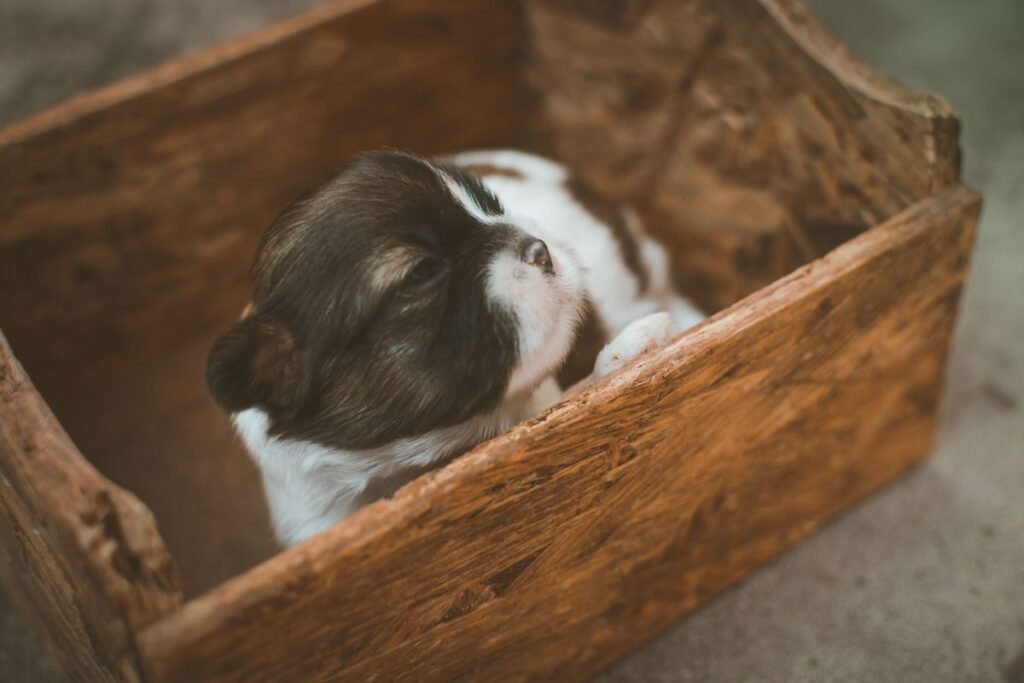
Whelping box pig rails are horizontal bars or shelves fixed around the inside of a whelping box, a few inches out from the wall and a few inches up from the floor, and they are the one feature that gives a puppy a chance when the dam lies down or rolls over on top of it. Without rails, a puppy caught between the dam's body and the wall has nowhere to go. With rails, there is a gap behind the bar, a pocket of space where the puppy can lie while the dam's body rests on the rail instead of on the puppy. That gap is the whole point of pig rails, and it is why every guide that covers them calls them the most important safety feature of the box. This article explains what they are, where they sit, what the conflicting measurements mean, and how to add them to a bought or built box.
Whelping box pig rails: what they are and how they work
A pig rail is a simple thing, and its simplicity is why it works. It is a bar, a dowel, a length of PVC pipe, or a wooden shelf, fixed horizontally along the inside wall of the box, running around the whole interior perimeter. The bar sits out from the wall by a few inches, and up from the floor by a few inches, and the space behind it, between the bar and the wall, and under it, between the bar and the floor, is the escape space. When the dam lies down against the wall, her body presses against the rail, not against the wall, and a puppy that is underneath her can slip into the gap behind the rail. When she rolls over in her sleep, the rail holds her body off the floor at the edge, and the puppy has room to move.
The names tell the same story in different words. Pig rails comes from pig farming, where rails in a farrowing pen protect piglets from being crushed by the sow. Whelp rails is the dog version of the same term. Roll bars and anti crush bars describe the same bar by what it does, it rolls the dam's body away from the wall, and it prevents crushing. Guard rail and safety shelf are other names used by makers and guides. They are all the same feature, and a box that has one of them has pig rails, whatever the maker calls them. The Purdue Canine Welfare Science whelping page describes the feature in plain terms: the ideal whelping box has a railing, known as a pig rail, around the edge, and this prevents the dam from accidentally laying on her puppies. Dogster describes bumper rails, also called roll bars or pig rails, around the inside of the box, preventing newborns being crushed or smothered against the sides.
The risk pig rails address is real, and it is also a risk that rival pages describe in stronger terms than the evidence supports. GestationCalc calls accidental crushing one of the leading causes of newborn puppy loss, without a sourced figure. PawToolkit calls pig rails the single most important safety feature, without a sourced figure. One search snippet found in research gave a figure of 60 to 70 percent of accidental crushing deaths prevented, and that figure is unverified here and is not repeated in this article. This article does not give a percentage, because no authoritative page opened for this article gives one. What the opened sources do say is that crushing against the wall is a known risk, that rails create a gap that reduces it, and that a box without rails leaves a puppy with nowhere to escape. That is enough to make rails essential, without inventing a figure to make the case stronger.
Do you need pig rails
Yes, for almost every box, and for every litter. The question is not whether pig rails help. It is whether there is a box or a litter where they do not matter, and the answer is that there is almost none. A first time dam is more likely to lie awkwardly, because she has never done this before, and she needs rails more, not less. An experienced dam is less likely to lie awkwardly, but she still rolls in her sleep, and she still lies down heavily after a long labour, and a puppy can still be underneath her. A small litter needs rails, because a single puppy alone against a wall has no litter mates to push it clear. A large litter needs rails more, because there are more puppies to be caught, and more bodies pressed against the walls.
The only case where rails matter less is a box that is used only for the first few days, with the dam watched constantly, but that is not how whelping works in practice. The dam and the puppies are in the box for three to four weeks, and no owner can watch them every minute of those weeks. Rails are the safety feature that works when no one is watching, at 3 in the morning, when the dam rolls over in her sleep. That is when they matter most.
If you are buying a box, choose one with rails fitted, on all four sides, rather than a box where rails are an optional extra. If you are building a box, build the rails in from the start, rather than adding them later as an afterthought. Inspired by Tyson, in a search snippet, advises building rails in from the start rather than as an add on, and that advice is sound, because rails fitted as part of the build are stronger, smoother and better placed than rails screwed on later. The build guide in DIY whelping box covers construction, and this article covers the rails themselves, so the two do not repeat each other.
Pig rail height and inset: the conflicting measurements
This is the part of the topic where rival guides disagree, and the disagreement is large enough to confuse a reader who compares two guides. The table below lists the figures each rival gives, with the source, so the reader can see the range instead of being given one number silently. No page from the American Kennel Club, Merck, VCA, Cornell or UC Davis opened for this article states a rail measurement, so every figure below is a breeder or maker convention, not a veterinary figure.
| Source | Height above floor | Inset out from wall |
|---|---|---|
| GestationCalc | About 4 to 5 inches | About 4 to 5 inches |
| PawToolkit | About 5 to 7 cm, about 2 to 3 inches | About 5 to 7 cm, about 2 to 3 inches |
| Whelper | About 3 to 4 inches, 8 to 10 cm | Gap behind the rail, no figure given |
| CoolAstro | 3 to 5 inches | 3 to 4 inches |
| Calculators for Dogs | 4 to 7 inches | 3 to 6 inches |
Read the table carefully. The height figures range from about 2 to 3 inches, in PawToolkit, to 4 to 7 inches, in Calculators for Dogs. The inset figures range from about 2 to 3 inches to 3 to 6 inches. Those ranges overlap, but they do not agree, and a reader who follows one guide will build rails at a different height from a reader who follows another. The reason for the disagreement is that the right height depends on the size of the dam and the size of the puppies, and a rail that is right for a Chihuahua litter is too low for a Great Dane litter. A small dam needs a low rail, because her body is low and a high rail would not hold her off a puppy. A large dam needs a higher rail, because her body is higher and a low rail would be under her body rather than beside it.
The practical way to choose is to work from your own dog, not from a table. Sit your dam beside the box, or lie her down in it, and look at where her body meets the wall when she lies on her side. The rail should sit at about the height of her body where it would press a puppy, so that her body rests on the rail and the puppy has space below and behind it. For most medium dogs, that is in the middle of the range above, about 4 inches above the floor and about 4 inches out from the wall, which is the GestationCalc figure and the middle of the other ranges. For a toy breed, use the lower end, about 3 inches. For a giant breed, use the upper end, about 5 to 6 inches. Check the rail by lying the dam down in the box and watching whether a puppy sized object, such as a rolled towel, can slip into the gap behind the rail when she lies against it. If it cannot, the rail is too close to the wall or too low. If the gap is so large that the dam can lie in it herself, the rail is too far out.
The rail should also be smooth, with no sharp edges, no screws sticking out, and no gaps where a puppy's leg or head can catch. Purdue warns that a whelping box with sharp edges can injure the dam's mammary glands and put her at risk for infection, and the same applies to rails. Sand wooden rails smooth, cap the ends of PVC pipe, and check metal rails for burrs. The rail must be fixed firmly, because a dam leaning on it will put her full weight on it, and a rail that comes loose can fall on a puppy.
Pig rails on all four sides, or only some
Pig rails should run around the whole interior perimeter, on all four sides, not on two sides or three. The reason is that the dam does not always lie against the same wall. She turns, she moves to a cooler part of the box, she lies with her head at one end one night and at the other end the next, and a puppy can be caught against any wall. A box with rails on only two sides leaves the other two sides unprotected, and the dam will find those sides. The claim that the American Kennel Club specifically recommends pig rails on all four sides was found in research only in a rival page asserting it, not in an AKC page opened for this article, and the AKC pregnancy page opened in full on 20 November 2026 does not mention pig rails at all. This article therefore does not present the four sides rule as an AKC recommendation. It presents it as the consistent advice of breeder guides and makers, and as the logical consequence of the dam moving around the box.
The same logic applies to the entry side. Some boxes have a low entry section for the dam, with a door or a cut down wall, and owners sometimes leave the rails off that side so the dam can step in easily. That is a mistake, because the entry side is a wall like any other, and a puppy can be caught against it. Fit the rail on the entry side as well, with a gap or a lower section at the entry point if needed, so the dam can step over the rail at the entry and the puppies still have a gap along the rest of that wall. If the entry is a door that opens, fit the rail to the door as well, so the gap is there whether the door is open or closed.
Materials: PVC pipe, wooden dowels and commercial rails
Pig rails can be made from PVC pipe, wooden dowels, wooden battens, or commercial metal rails, and each material has strengths and weaknesses. PVC pipe is the most common DIY choice, because it is smooth, easy to clean, and easy to cut to length. GestationCalc advises adding rails with 2 inch PVC pipe, wooden dowels or commercial metal rails. Use pipe with a diameter of about 2 inches, so it is thick enough to hold the dam's body off the wall, and cap the ends so there are no open tubes where a puppy can catch a leg. Fix the pipe to the wall with brackets that hold it firmly, and check that it does not rotate or spin when the dam leans on it, because a spinning pipe can trap a puppy's leg.
Wooden dowels are also common, and they have the advantage of being easy to fix to a wooden box. Use a dowel thick enough to hold the dam's weight, at least 1.5 inches in diameter for a medium dog, and sand it smooth. Wooden battens, a flat shelf rather than a round bar, are another option, and they have the advantage of creating a wider shelf that a puppy can lie under. A shelf should be at least 3 inches wide, so it creates a clear gap, and it should be fixed firmly to the wall with brackets underneath, not just screwed to the wall at the ends.
Commercial metal rails are the strongest option, and they are often adjustable in height, which is useful if you whelp different sized dogs in the same box. EZ Whelp, in a search snippet, notes that its rails have three adjustable heights and are removable when no longer required. Removable rails are useful, because rails are needed most in the first three to four weeks, when the puppies are small and cannot move away, and they can be removed later when the puppies are larger and more mobile. If you buy commercial rails, check that they fit your box, that they are smooth, and that they can be removed without leaving screws or brackets sticking out.
Whatever material you use, the rail must be easy to clean. The box will be cleaned daily, and the rail will get dirty with birth fluids, urine and milk. A rail that cannot be wiped clean, or that has a rough surface that traps dirt, is a hygiene problem. PVC and metal are easy to wipe. Wood needs to be sealed with a non toxic waterproof paint or varnish, so it does not absorb fluids, and it needs to be checked for cracks where dirt can collect.
How to add pig rails to a box that has none
If you already have a box without rails, add them before the litter arrives, not after. Adding rails to a box with puppies in it disturbs the dam, and it risks a puppy being caught while the rails are being fitted. The best time to add rails is when the box is set up, on day 49, as part of the setup routine in when to set up whelping box. Measure the interior of the box, cut the rails to length, and fix them around all four sides at the height you have chosen for your dog. Check that the rails are level, that they are firmly fixed, and that there are no sharp edges or protruding screws.
For a plastic box, such as a children's paddling pool, which the AKC notes many breeders use as a whelping box, the Purdue page advises a practical method: add a railing by zip tying a pool noodle around the edge. A pool noodle is soft, smooth and easy to fix, and it creates a gap that a puppy can slip into. It is not as strong as a wooden or metal rail, and it will not hold a large dam's body off a puppy as firmly as a fixed bar, but it is better than no rail at all, and it is a useful temporary solution for a first litter. Check the noodle regularly, because a dam can chew it, and replace it if it is damaged.
For a wooden box, screw brackets to the walls at the chosen height, then fix the rail to the brackets. Use brackets at least every 18 inches, so the rail does not flex in the middle when the dam leans on it. For a box with a waterproof base, make sure the brackets do not pierce the waterproof layer, or seal any holes you make. After fitting, lie the dam down in the box and check the gap, as described above, and check that she can step in and out over the rail at the entry point without difficulty. If she cannot, lower the entry section of the rail, or add a step outside the box, rather than removing the rail.
When to remove pig rails
Pig rails are needed most in the first three to four weeks, when the puppies are small, cannot move away, and cannot climb out of the box. After that, the puppies become mobile, they can stand, walk and climb, and they can move away from the dam when she lies down. At that point the rails become less important, and they can be removed if they are removable, or left in place if they are fixed. The transition out of the box is covered in how long do puppies stay in whelping box, and the point here is that rails do not need to stay in for eight weeks. If the rails are removable, take them out when the puppies move to a larger pen, around four weeks, so they have more floor space and cannot catch a leg in the rail as they climb. If the rails are fixed, leave them in, and check that the puppies cannot climb on them to get out of the box early.
Do not remove the rails early, in the first two weeks, because that is when the puppies are most vulnerable. A puppy that is two weeks old cannot move away from the dam, cannot regulate its own temperature, and cannot survive being pinned for long. The rails are the protection for that period. A puppy that is four weeks old can move, can climb, and can call for help, and the rails are less critical. Use the puppies' mobility as the guide, not a fixed date, and if in doubt, leave the rails in for another week.
What rivals get wrong about pig rails
Rival pig rail pages share three weaknesses. The first is that they give a single measurement without stating the range, so a reader who follows one guide builds rails at a different height from a reader who follows another, and neither knows the other exists. GestationCalc gives 4 to 5 inches, PawToolkit gives 5 to 7 centimetres, and CoolAstro gives 3 to 5 inches, and none of them notes the disagreement. This article gives the full range in a table, with the source for each figure, and explains how to choose inside the range from your own dog's size. The second weakness is that rival pages assert an AKC recommendation without quoting it. Inspired by Tyson, in a search snippet, states that the AKC specifically recommends pig rails on all four sides, but the AKC page opened for this article does not mention pig rails at all. This article does not repeat that claim as an AKC fact. The third weakness is that rival pages give a loss figure without a source. GestationCalc calls crushing one of the leading causes of newborn loss, and a search snippet gave a 60 to 70 percent prevention figure, and neither is sourced. This article gives no percentage, because no authoritative page opened for this article gives one.
The most useful rival page for pig rails is GestationCalc, because it is the only rival that explains the gap, gives a material list, and calls the feature the most important feature of the box. Its gap is that it gives one measurement as if it were the only measurement, and it gives a loss claim without a source. PawToolkit is the second most useful, because it gives the metric figures and the material list, but its figures conflict with GestationCalc by a factor of two, and it does not note the conflict. This article brings the figures together, states the conflict, and gives a method for choosing inside the range.
Check your rails before the due date
Check your box for pig rails now, while there is still time to add them. Look inside the box, run your hand around all four sides, and ask whether a puppy caught between the dam and the wall would have somewhere to go. If the answer is no, add rails before the setup date, and check them with the dam lying down in the box. To check the date, enter your mating or ovulation date in the dog due date calculator and note the full window, not just the central date, because gestation from a mating date is 58 to 72 days, while gestation from ovulation is around 63 days for all breeds. The step by step calculation is set out in How to Calculate a Dog's Due Date, and How Long Are Dogs Pregnant? gives the gestation figure in full. A box without rails is a box with a known gap in its safety, and the gap is cheap to fix now and expensive to discover later.
Frequently asked questions
What are pig rails on a whelping box?
Pig rails are horizontal bars or shelves around the inside of a whelping box, a few inches out from the wall and a few inches up from the floor. They create a gap so a puppy caught beneath the dam as she lies down has space to escape instead of being pinned against the wall.
What are pig rails for and why do I need them?
They protect newborn puppies from being crushed or smothered against the walls when the dam lies down or rolls over. Without rails, a puppy caught between the dam's body and the wall has nowhere to go. With rails, there is a gap behind the bar where the puppy can lie safely.
Are pig rails removable?
Some are, and some are not. Commercial metal rails are often removable and adjustable in height, and EZ Whelp notes its rails have three adjustable heights and are removable when no longer required. DIY rails made from PVC pipe or wood are usually fixed, and they can be left in place after the puppies move out of the box.
How high should pig rails be?
Rival guides disagree, giving 3 to 5 inches, 4 to 5 inches, 4 to 7 inches, and 5 to 7 centimetres, which is about 2 to 3 inches. No authoritative page opened for this article states a rail measurement. For most medium dogs, about 4 inches above the floor and about 4 inches out from the wall is the middle of the range. Use the lower end for a toy breed and the upper end for a giant breed, and check the gap with your dam lying down.
Do I need pig rails on all four sides?
Yes. The dam turns and moves around the box, and a puppy can be caught against any wall. Fit rails around the whole interior perimeter, including the entry side, with a lower section at the entry point if needed so the dam can step in easily.
How do I add pig rails to a DIY whelping box?
Fix a bar, dowel, PVC pipe or wooden shelf horizontally around the inside walls, about 4 inches above the floor and about 4 inches out from the wall for a medium dog, with brackets at least every 18 inches. Sand it smooth, check for sharp edges and protruding screws, and test the gap with the dam lying down before the litter arrives.
Sources
- Purdue University, Canine Welfare Science, Croney Research Group, "Setting Up a Welfare-Friendly Whelping Area." https://caninewelfare.centers.purdue.edu/category/behavior/puppy-development/maternal-care/feed/ — Ideal whelping box has a railing, known as a pig rail, around the edge; prevents the dam from accidentally laying on her puppies; box must be large enough for dam to stretch out; sharp edges can injure mammary glands. Opened in full 20 November 2026.
- GestationCalc, "Whelping Box Setup." https://gestationcalc.com/blog/whelping-box-setup — Pig rails are the most important feature; ledge or bar around interior perimeter, about 4 to 5 inches from floor and 4 to 5 inches from side walls; add with 2 inch PVC pipe, wooden dowels or commercial metal rails. Opened in full.
- PawToolkit, "Whelping Box Setup and Birth Preparation." https://www.pawtoolkit.com/blog/whelping-box-setup-and-birth-preparation — Pig rails are the single most important safety feature, about 5 to 7 cm from floor and 5 to 7 cm from walls; made from PVC pipe, wooden dowels or shelf brackets. Opened in full.
- Whelper, "Whelping Prep." https://whelper.com/learn/whelping-prep — Guard rail about 3 to 4 inches, 8 to 10 cm, off the floor, with a gap behind it. Opened in full.
- Dogster, "Whelping Box for Dogs." https://www.dogster.com/dog-health-care/whelping-box-for-dogs/ — Bumper rails, roll bars or pig rails, around the inside prevent newborns being crushed or smothered against the sides. Opened in full.
- Calculators for Dogs, "Whelping Box Size Calculator." https://www.calculatorsfordogs.com/age-life-stage-calculators/whelping-box-size-calculator — Pig rails 3 to 6 inches inset and 4 to 7 inches high. Opened in full.
- American Kennel Club, "Dog Pregnancy: Signs, Care, and Preparing for Puppies." https://www.akc.org/expert-advice/health/dog-pregnancy-care-prep/ — No mention of pig rails on the page opened in full 20 November 2026; used here to check the AKC attribution claim, which was not verified. Opened in full.
- CoolAstro, "DIY Whelping Box Dogs Setup Safety Guide." https://coolastro.com/diy-whelping-box-dogs-setup-safety-guide/ — Install rails 3 to 5 inches up from floor and 3 to 4 inches out from wall, around entire inner perimeter; use wooden dowels, 2 by 4s or PVC pipe. Search snippet only.
- EZ Whelp, "Frequently Asked Questions." https://www.ezwhelp.com/pages/frequently-asked-questions — Pig rails are a must for every whelping box; rails have 3 adjustable heights; rails are removable when no longer required. Search snippet only.
Where sources disagree, the disagreement is stated in the article rather than picking one figure silently: rail height and inset figures conflict across rivals, and the AKC four sides claim was not verified against an AKC page opened here.
Disclaimer
This article is general information only. It cannot tell you whether a dog is pregnant, diagnose any condition, or stand in for veterinary advice. Calculator results on this site are estimates. If you think your dog may be pregnant, or if anything in this guide worries you, speak to your veterinarian.
Keep reading

My Dog Is Pregnant: What Do I Do Now
Your dog is pregnant and it was not planned. Start here: confirm it, book the vet, work out the due date, and…

Dog Pregnancy Preparation Guide Before Due Date
Get ready before the due date in three waves: the vet plan and puppy count, the room and whelping box, and the…

How to Care for a Pregnant Dog for the First Time
Your dog is pregnant for the first time, and you have never done this before. Start with confirmation and a vet plan,…