Dog Pregnancy Ultrasound vs X-Ray: Which Test When
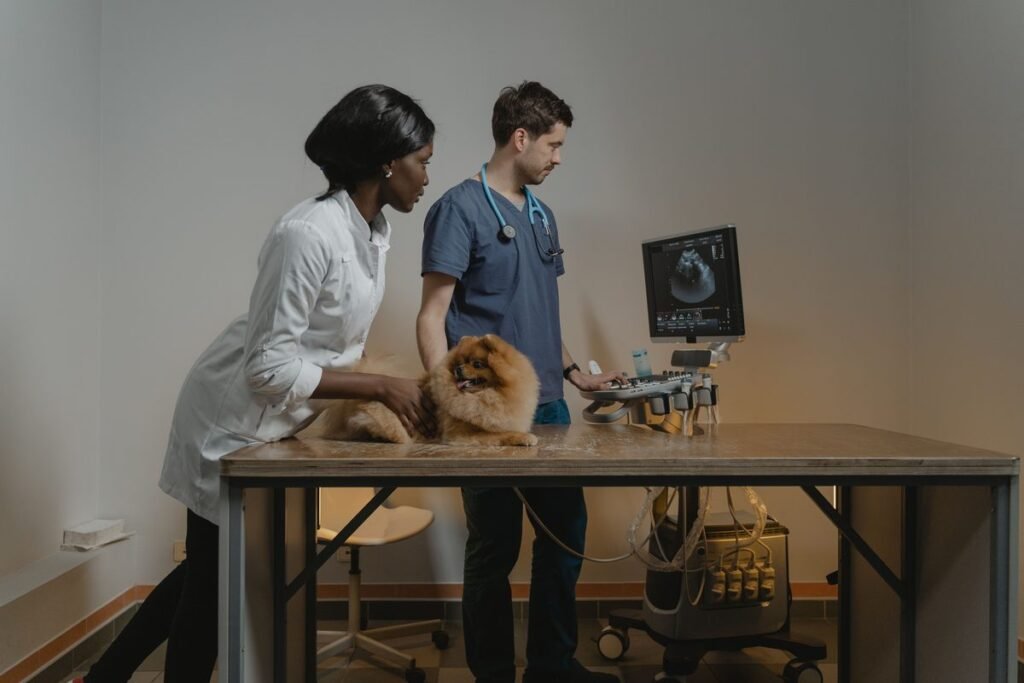
Dog pregnancy ultrasound vs X-ray is not a contest with one winner. The two tests answer different questions at different times, and the right choice depends on which question you are asking. Ultrasound is the better choice early, from about day 25 to 35, because it can show whether she is pregnant, whether the puppies are alive, and roughly how far along she is, using sound waves rather than radiation. X-ray is the better choice late, after day 55, because the puppies' skeletons show up clearly on film and the vet can count them, judge their size against the mother's pelvis, and plan the birth. If you need to know whether she is pregnant and whether the puppies are alive, book an ultrasound. If you need to know how many puppies there are, book an X-ray after day 55. Many owners need both, at different times, for different reasons.
Dog pregnancy ultrasound vs X-ray: the comparison at a glance
| Ultrasound | X-ray (radiograph) | |
|---|---|---|
| What it uses | Sound waves | Ionising radiation |
| When it is used | From about day 21 to 25, reliable 25 to 35 days, best after day 28 | Skeletons about day 43 to 45, best count after day 55 |
| What it answers | Is she pregnant? Are the puppies alive? Roughly how far along is she? | How many puppies? What size are they? What position are they in? |
| What it shows | Gestational sacs, embryos, heartbeats, movement, growth | Skulls, spines, ribs, pelvis, puppy position |
| Counting | Gives an estimate of litter size, never a reliable count | Best available count, after day 55, still not exact |
| Viability | Only common method that confirms puppies are alive, by heartbeat | Can usually determine viability, but sudden death of a full term puppy is difficult to detect |
| Safety | Not invasive, no radiation, can be repeated | Low dose late in pregnancy, avoided early, done when benefit outweighs risk |
| Repeat use | Can be repeated as needed | Used sparingly, usually once late and once after whelping if needed |
The table is the decision guide. The rest of this article explains each row, so you can see why the two tests sit where they do and what happens when the wrong test is used for the wrong question.
Timing: early versus late
Timing is the first difference and the one that decides most choices. Ultrasound works early. Embryos are detectable as early as about three weeks, according to VCA, and the scan is reliable from 25 to 35 days, most reliably after day 28, according to the Merck manual and the AKC. A scan booked at about day 28 to 32 gives the clearest early answer: the fetuses are distinct, the heartbeats are usually visible, and the vet can check viability.
X-ray works late. Skeletons first become visible at about day 43 to 45, according to VCA and Merck, and the count is best after day 55, according to Merck and the AKC. A radiograph taken before day 42 shows a fluid filled uterus and no skeletons, according to Canine Pregnancy Scanning, a scanning business page opened in full for this article, and a count from it is meaningless. A radiograph taken at day 45 shows skeletons, but they are faint, and the count is rough. A radiograph taken at day 55 or later shows the clearest skeletons and gives the best count.
The two windows do not overlap in any useful way. There is no day on which both tests are at their best, and there is no day on which the X-ray can do the ultrasound's early job. An owner who is offered a radiograph at day 30 to confirm a pregnancy should ask why, because the skeletons will not be visible yet and the film will not answer the question. An owner who is offered an ultrasound at day 58 to count the puppies should ask the same question in reverse, because the scan cannot give a firm count at any stage, and the radiograph is the tool for that job.
Two rival windows need labels here. KinTek, a vendor FAQ page, gives after day 50 as the radiograph count standard. That is earlier than the Merck and AKC day 55 plus rule, and this article follows Merck and the AKC. Van Isle Veterinary Hospital gives radiographs typically done between 53 and 56 days, which is a clinic preference, not a standard, and this article does not present it as one. The CanineCalc ultrasound cost page, opened in full for this article, gives the same split this article uses: ultrasound from about day 25 to 30 for confirmation and heartbeat checks, radiograph after about day 45 for counting, with the count best later.
What each test shows, and what it cannot show
Ultrasound shows living things in motion. The vet sees gestational sacs, embryos, fetal heartbeats as a rapid flicker inside the chest, fetal movement, and the growth of organs as the pregnancy progresses. The vet can also estimate how far along the pregnancy is from measurements of the puppies in mid pregnancy, according to Cornell, although that estimate is based on fetal size and is not as precise as a due date counted from a known ovulation date. The vet can see whether the puppies look broadly normal in size and movement for the stage, and can check individual heart rates as whelping approaches.
What ultrasound cannot show is a firm puppy count. The image shows only part of the womb at a time, puppies hide behind each other. A fetus can be missed or counted twice. The AKC states that ultrasound gives an estimate of the number of puppies, and VCA states that it can be difficult to count the number of fetuses accurately on ultrasound. CanineCalc puts it plainly: the vet may give an estimate such as at least three or four or five, but the owner should not plan whelping supplies or homes around that number alone. Ultrasound also cannot predict the whelping date precisely, according to CanineCalc and the Merck manual.
X-ray shows bones. The vet sees skulls, spines, ribs and the mother's pelvis, and can judge the size of each puppy's skull against the pelvic canal, which matters for birth planning and for deciding whether a caesarean may be needed. The vet can see the position of the puppies, head first or breech, and can judge which puppy is likely to come first. The vet can count the skulls and spines, with the limits described below.
What X-ray cannot show is heartbeats. A radiograph is a still image of bones, and it cannot tell the vet whether a puppy's heart is beating. VCA states that viability can typically be determined on a radiograph, but that the sudden death of a full term puppy in the uterus would be difficult to detect on one. If the question is whether the puppies are alive, the ultrasound is the tool, and the radiograph is not. The radiograph also cannot show the early pregnancy at all, because there are no skeletons to image before day 42.
Counting: the question that separates the two tests
Counting is the question on which the two tests differ most, and it is the question most owners ask first. The answer is simple to state and important to understand: ultrasound gives an estimate of litter size, and X-ray at day 55 plus gives the best count, and neither gives an exact number.
Ultrasound counting fails for practical reasons that every rival page agrees on, even when they disagree on everything else. The image shows only part of the womb at a time. Puppies move, overlap and hide behind each other. A fetus can be missed or counted twice as it moves between scan planes. Intestinal gas obscures the view. KinTek, a vendor FAQ page, states that ultrasound is not a reliable tool for accurately counting puppies, because the uterine horns are long and puppies can easily hide behind one another or be obscured by intestinal gas, and that a puppy count via ultrasound should always be considered a rough estimate, not a definitive number. Essential Foods, a snippet only rival, puts it the same way: the fetuses lie close together and can hide one another, and a fetus can easily be counted twice or not at all.
X-ray counting is better, but it is not perfect. Skeletons overlap on the film, gas and faeces can hide a skull or look like one, and very large litters crowd the image. Canine Pregnancy Scanning reports that puppies can be missed on a radiograph, that different viewers can count different numbers from the same film, and that a count of seven is usually told to the owner as seven plus or minus one, because puppies hide behind each other. That plus or minus one convention is practitioner reported, not a verified statistic, and this article presents it as such. No authoritative source opened for this article gives an accuracy percentage for either test's count, and this article does not invent one.
Two rival counting errors belong here. On the ultrasound question, lima Fitzrovia states that an ultrasound at 3 to 4 weeks gives an exact puppy count. That directly contradicts the AKC and VCA, and it is wrong. No ultrasound gives an exact count. Brookhurst Animal Medical Center states that a second scan around days 40 to 50 gives a more accurate count of puppies. That conflicts with the authoritative position and with the practical fact that larger puppies overlap more, so later scans are harder to count from, not easier. This article does not repeat either claim.
The counting question is worked in full in the two deep dive articles: the ultrasound counting guide for the scan side, and the radiograph count accuracy guide for the film side. This article covers counting only as one row of the comparison, and links to both rather than repeating them.
Viability: the question only ultrasound can answer
Viability, whether the puppies are alive, is the question that most clearly separates the two tests. Ultrasound is the only common method that confirms viability, because it shows heartbeats. VCA states that ultrasound is the most reliable way to detect and monitor pregnancy and to assess whether the puppies are alive. The AKC states that an ultrasound between 25 and 35 days can usually detect fetal heartbeats. A heartbeat seen on a scan confirms viability at the time of the examination only, and one healthy fetus does not confirm that every fetus in the litter is healthy, but it is the only direct evidence of life that any routine test gives.
The radiograph cannot do this. It shows bones, and bones do not beat. A puppy that died recently can still have a visible skeleton on a radiograph, and VCA states that the sudden death of a full term puppy would be difficult to detect on one. Palpation cannot do it either, and a relaxin blood test cannot do it, because the test detects placental tissue, not heartbeats. If the owner's worry is whether the puppies are alive, the answer is an ultrasound, at any stage from week 5 onwards, and the radiograph is not a substitute.
The heartbeat question is covered in full in the heartbeat guide, including when heartbeats first appear, what the UC Davis at term heart rate figures mean, and what it means if no heartbeat is seen. This article states the comparison only: ultrasound shows life, radiograph shows bones.
Safety: sound waves versus radiation
Safety is the second difference owners ask about, and the answer is straightforward. Ultrasound uses sound waves, not ionising radiation. It is not invasive, it can be repeated, and the vet will keep the scan as short as needed and stop if the dog becomes stressed. CanineCalc's ultrasound cost page, opened in full, states that ultrasound is generally considered safe for pregnant dogs, uses sound waves rather than radiation, and is widely used in veterinary care. There is no dose to track and no cumulative exposure to worry about, which is why a pregnancy may need more than one scan without concern.
X-ray uses ionising radiation, and it is used sparingly and late. On the ultrasound question, a single late pregnancy diagnostic radiograph is considered low dose and is done when the benefit outweighs the risk, and radiographs are avoided early in pregnancy. That is as far as the authoritative sources opened for this article go. Dr Roger Hart gives dose figures, 30 to 50 mrem and a 0.05 Gy threshold, but those figures are stated without a cited source on the page, and this article does not copy them. Canine Pregnancy Scanning states that ultrasounds are extremely safe as opposed to radiographs, which should only be carried out in moderation, and that after 42 days most vets believe from day 55 onwards is safer for a radiograph. That last point is a practitioner view, not a veterinary standard, and it is consistent with the Merck and AKC day 55 plus rule, so it is noted here and not presented as a separate rule.
The safety split follows the timing split. Ultrasound is the early test partly because it is safe to use early and to repeat. Radiograph is the late test partly because the radiation is only justified when the information it gives, the count and the birth plan, is worth having, and that is only true late in pregnancy when the skeletons are visible.
Do you need both
Many owners do need both, and that is not a sign that the vet is selling extra tests. It is a sign that the two tests answer different questions at different times. The usual sequence is an ultrasound in week 5, around day 28 to 32, to confirm the pregnancy, check viability, and estimate how far along she is, followed by a radiograph after day 55 to count the puppies, check their size against the pelvis, and plan the birth. CanineCalc makes the same point: if the vet suggests both, it is not usually about selling extra tests, it is about using each method at the time when it gives the clearest answer.
There are pregnancies that need only one. If the owner only needs to know whether she is pregnant and whether the puppies are alive, an ultrasound is enough, and a radiograph adds nothing. If the owner already knows she is pregnant from a blood test and only needs a count for whelping day, a radiograph after day 55 may be the only imaging needed, although the vet will usually still want an ultrasound to check viability before the birth. If the owner needs a count and the radiograph is unclear, an ultrasound will not fix the count, because the scan cannot count either. In that case the vet may suggest a repeat radiograph, or a second reader, rather than a different test.
Sage Veterinary Imaging, a specialist clinic page, states the complementary point well: ultrasound is better for early detection, viability, heart rates and fetal distress, radiographs after day 45 are generally more accurate for counting, and both modalities play important complementary roles. KinTek states it the same way: ultrasound and radiography are best viewed as complementary tools, ultrasound confirms pregnancy and health, while radiography confirms the final count. The two tests are partners, not rivals, and the article that treats them as a contest has misunderstood both.
A worked example: one pregnancy, two tests, two dates
Take a bitch mated on Friday 20 November 2026. Count day 1 as the day after mating. The ultrasound window opens at day 21, Friday 11 December 2026, becomes reliable at day 25, Tuesday 15 December, and is best at day 28 to 32, Friday 18 to Tuesday 22 December 2026. The radiograph window opens at day 42, Friday 1 January 2027, shows skeletons reliably at day 45, Monday 4 January, and gives its best count at day 55, Thursday 14 January 2027. On the ultrasound question, the due date, counted from ovulation on Thursday 19 November 2026, is Thursday 21 January 2027.
Now place the two tests on that calendar. An ultrasound on Tuesday 22 December, day 32, should show distinct fetuses with heartbeats, confirm the pregnancy, check viability, and give an estimate of how far along she is. A radiograph on Thursday 14 January, day 55, should show clear skeletons and give the best count, with the skulls measured against the pelvis for the birth plan. An ultrasound on Thursday 14 January would still show heartbeats, but it would not give a reliable count, and a radiograph on Tuesday 22 December would show a fluid filled uterus and no skeletons, and would answer nothing.
The cost question is the one this article does not answer with numbers. CanineCalc's ultrasound cost page gives a broad United States guide of 250 to 500 dollars for a single scan, and a scanning business page gives 20 pounds in the United Kingdom and around 500 dollars in America, but those are rival estimates, not verified prices, and they vary by clinic, region, and what is included. This article does not copy any price figure. If cost matters, ask the clinic what is included before you book, for each test separately, and compare the inclusions, not just the headline figures.
Questions to ask your vet
On the ultrasound question, take these to the vet visit, with the mating dates written down. Ask which question the vet is trying to answer, and which test answers it. Ask what day of the pregnancy the dog is on by the clinic's count, and whether that day falls inside the reliable window for the test being suggested. Ask what the test will show and what it will not show, especially whether it can count the puppies or confirm they are alive. Ask whether both tests are needed, and if so, when each one should be booked. Ask what the radiograph will show about skull size and pelvis that the ultrasound cannot, and what the ultrasound will show about heartbeats that the radiograph cannot. Ask whether a repeat scan or a repeat radiograph is likely, and what would prompt one.
A calculator gives an estimate only. It never confirms a pregnancy. It never takes the place of a scan or a radiograph. On the ultrasound question, to check the date you have, enter the mating or ovulation date in the dog due date calculator and note the full window, not just the central date. The how to calculate guide works through the counting method. The accuracy guide explains how much weight to give each kind of result.
Frequently asked questions
Ultrasound or X-ray: which is better for a pregnant dog?
Neither is better in general. Ultrasound is better early and for checking viability, X-ray is better late and for counting puppies. The right question is not which test is better, but which question you are asking. If you need to know whether she is pregnant and whether the puppies are alive, book an ultrasound. If you need to know how many puppies there are, book an X-ray after day 55. Many owners need both, at different times.
When can a dog have an ultrasound to confirm pregnancy?
An ultrasound can first show embryos at about three weeks, and it is reliable from 25 to 35 days, most reliably after day 28. A scan booked at about day 28 to 32 gives the clearest early answer: the fetuses are distinct, the heartbeats are usually visible, and the vet can check viability. A scan in week 3 may show gestational sacs, but the picture is faint and a negative scan at that stage does not mean the dog is not pregnant.
When can a dog have an X-ray to confirm pregnancy?
An X-ray cannot confirm pregnancy early at all. Skeletons first show at about day 43 to 45, and the count is best after day 55. A radiograph taken before day 42 shows a fluid filled uterus and no skeletons, so it cannot confirm anything. If the question is whether she is pregnant, the radiograph is the wrong test and the wrong time. If the question is how many puppies there are, it is the right test, booked after day 55.
Can an ultrasound count puppies?
An ultrasound gives an estimate of litter size, not a reliable count. The image shows only part of the womb at a time, puppies hide behind each other, and a fetus can be missed or counted twice. The AKC states that ultrasound gives an estimate of the number of puppies, and VCA states that it can be difficult to count the number of fetuses accurately on ultrasound. For a count, book a radiograph after day 55.
Is an X-ray safe for a pregnant dog?
An X-ray uses ionising radiation, and it is used sparingly and late, when the benefit outweighs the risk. A single late pregnancy diagnostic radiograph is considered low dose. Radiographs are avoided early in pregnancy, because there is nothing to see before day 42 and the radiation is not justified. Ultrasound, which uses sound waves rather than radiation, is the safer early test and can be repeated.
Does my dog need both an ultrasound and an X-ray?
Many owners do need both, at different times, for different reasons. The usual sequence is an ultrasound in week 5, around day 28 to 32, to confirm the pregnancy, check viability, and estimate how far along she is, followed by a radiograph after day 55 to count the puppies and plan the birth. If you only need to know whether she is pregnant and whether the puppies are alive, an ultrasound is enough. If you only need a count, a radiograph after day 55 may be the only imaging needed.
What happens at the first vet visit for a pregnant dog?
The vet takes a history, including the mating and heat dates, examines the dog generally, and chooses a test based on the day of the pregnancy. The vet will also talk about feeding, exercise, and the schedule of visits through the pregnancy. A negative result early on is not a final answer, and a positive result usually leads to an ultrasound to check that the puppies are alive.
Sources
- VCA Hospitals, "Pregnancy Testing in the Dog." https://vcahospitals.com/know-your-pet/pregnancy-testing-in-the-dog — Ultrasound reliable from day 28, embryos detectable as early as about 3 weeks, radiographs the best way to determine puppy numbers, viability usually determinable on radiograph but sudden death of a full term puppy difficult to detect, counting fetuses on ultrasound difficult.
- American Kennel Club, "Dog Pregnancy: Signs, Care, and Preparing for Puppies." https://www.akc.org/expert-advice/health/dog-pregnancy-care-prep/ — Ultrasound at 25 to 35 days, heartbeats usually detectable, ultrasound can give an estimate of the number of puppies, radiograph best at 55 days or more.
- Merck Veterinary Manual, Dog Owners, "Management of Reproduction in Dogs." https://www.merckvetmanual.com/dog-owners/reproductive-disorders-of-dogs/management-of-reproduction-in-dogs?query=reproductive — Ultrasound reliably detects pregnancy by 25 to 35 days, skeletons visible on radiograph after about day 43 to 45, radiographs after 55 days the best way to determine litter size.
- Cornell University College of Veterinary Medicine, Riney Canine Health Center, "The normal whelping process." https://www.vet.cornell.edu/departments-centers-and-institutes/riney-canine-health-center/canine-health-topics/normal-whelping-process — Gestation about 63 days from ovulation, fetal size based dating.
- CanineCalc, "Dog Pregnancy Test: Types, Cost + Accuracy (2026)." https://caninecalc.com/dog-pregnancy-test/ — Comparison table: relaxin 25 to 30, ultrasound 25 to 30, palpation 21 to 35, radiograph after about 45. Rival page, opened in full.
- CanineCalc, "How Much Does a Dog Ultrasound Cost?" https://caninecalc.com/dog-ultrasound-cost/ — Ultrasound considered safe, sound waves not radiation, radiograph after about 45 for counting, ultrasound gives estimate not count. Rival page, opened in full.
- Canine Pregnancy Scanning, "Understanding Puppy Counts: Why X-rays Aren't Always Accurate." https://caninepregnancyscanning.co.uk/ — Radiographs before day 42 show a fluid filled uterus and no skeletons; puppies can be missed; different viewers count differently; a count of 7 is given as 7 plus or minus 1. Practitioner page, opened in full.
- KinTek, "Ultrasound vs X-Ray for Pregnant Dogs: What's the Difference?" Vendor FAQ, SERP only, no URL in file. Counting ultrasound unreliable, uterine horns long, puppies hide behind each other, intestinal gas obscures, count is a rough estimate. Used from SERP only.
- Sage Veterinary Imaging, "Ultrasound vs. Radiographs in Canine Pregnancy: How Do Vets Confirm Pregnancy?" Specialist clinic page, SERP only, no URL in file. Ultrasound better for early detection, viability, heart rates, fetal distress; radiographs after day 45 generally more accurate for counting; both modalities complementary. Used from SERP only.
Where sources disagree, the disagreement is stated in the article rather than picking one figure silently: the radiograph count window is after day 55 (Merck, AKC), typically 53 to 56 days (Van Isle clinic preference), and after day 50 (KinTek vendor FAQ), and the article follows Merck and the AKC; Sage Veterinary Imaging and KinTek were used from SERP only and are not cited as sources with URLs.
Disclaimer
This article is general information only. It cannot tell you whether a dog is pregnant, diagnose any condition, or stand in for veterinary advice. Calculator results on this site are estimates. If you think your dog may be pregnant, or if anything in this guide worries you, speak to your veterinarian.
Keep reading

My Dog Is Pregnant: What Do I Do Now
Your dog is pregnant and it was not planned. Start here: confirm it, book the vet, work out the due date, and…

Dog Pregnancy Preparation Guide Before Due Date
Get ready before the due date in three waves: the vet plan and puppy count, the room and whelping box, and the…

How to Care for a Pregnant Dog for the First Time
Your dog is pregnant for the first time, and you have never done this before. Start with confirmation and a vet plan,…