Dog Pregnancy Blood Test: How It Works and When
A dog pregnancy blood test is the earliest reliable way to confirm that a dog is pregnant. It looks for a hormone called relaxin in a sample of blood, and relaxin is made only by the placenta, so finding it means there is placental tissue, and placental tissue means a pregnancy. No urine test works for dogs, no home test works for dogs, and no sign you can see at home is reliable in the first three weeks. This article explains what the blood test is, how it works, when to do it, what it can and cannot tell you, and what to do when the result does not match what you expected.
What is a dog pregnancy blood test
A dog pregnancy blood test looks for relaxin in the blood. Relaxin is a hormone produced by the placenta, the organ that forms around the embryos after they implant in the uterus. The embryos implant at about 15 to 18 days after mating, according to the AKC, and relaxin becomes detectable in the blood after that. The test is usually done from day 28 after mating, when relaxin levels are high enough to be reliable, and the earliest detection times quoted by the sources differ because they count from different starting points: about 20 to 25 days after fertilisation, according to the Merck Veterinary Manual, 22 to 27 days after breeding, according to VCA Hospitals, and 25 to 30 days after breeding, according to the AKC. A test that is positive means the dog was pregnant when the blood was drawn. A test that is negative means relaxin was not found, which can mean the dog is not pregnant or that the test was done too early.
The word relaxin is worth unpacking, because it explains why the test works and also why it has limits. Relaxin is a hormone produced by the placenta in the dog, and in the dog the placenta is the only source of relaxin in the blood during pregnancy. The hormone appears after implantation and rises as the pregnancy develops, peaking at about day 40 to 50, then dropping at parturition, according to the Merck manual. That pattern is the reason the test has a window: too early and there is not enough relaxin to detect; too late and the hormone is already falling. The relaxin test accuracy guide explains what the result means and when to trust it.
The test is used after mating, once implantation has happened, and it is the first test a vet can offer that can confirm a pregnancy. It is not the first thing that happens after mating: a vet may check the dog's general health first, and a breeder may wait for the first signs, but the blood test is the first test that gives a yes or no answer. It is also the only blood test for dog pregnancy. There is no blood test for progesterone that confirms pregnancy, no urine test, and no test that counts the puppies. The blood test answers one question: is there placental tissue making relaxin? Everything else, the number of puppies, whether they are alive, and the due date, needs a different test or a calculation.
The placenta and relaxin, in plain language
The placenta is the organ that grows around each embryo after implantation and connects it to the uterus. It passes oxygen and nutrients to the embryo and carries waste away, and it makes relaxin. Relaxin has a job in the pregnancy: it softens the tissues of the birth canal and prepares the body for birth, and it is made in larger amounts as the pregnancy goes on. In the dog the placenta is the only source of relaxin during pregnancy, which is what makes the hormone a marker of pregnancy, and the vet confirmation timeline gives the earliest reliable date for each confirmation method.
The timing follows from the biology. Implantation happens at about 15 to 18 days, and relaxin appears in the blood after that. The Merck manual gives the first detection at 20 to 25 days after fertilisation. VCA Hospitals gives 22 to 27 days after breeding. The AKC gives 25 to 30 days after breeding. The Merck owner manual gives 30 to 35 days. Those are not four different facts. They are four measurements taken from different starting points, and the relaxin accuracy guide puts all four on one calendar, with the same bitch mated on Friday 20 November 2026, so you can see the difference between them.
Relaxin levels rise as the pregnancy develops, peak at about day 40 to 50, and drop at parturition. After whelping, relaxin is not detectable by day 7, according to the Merck owner manual. During lactation, however, relaxin may remain detectable for up to 50 days, according to the Merck manual. That means a positive test in a bitch that is still nursing from a previous litter does not prove a new pregnancy, and a vet will ask about nursing before reading a result.
How the test is done, step by step
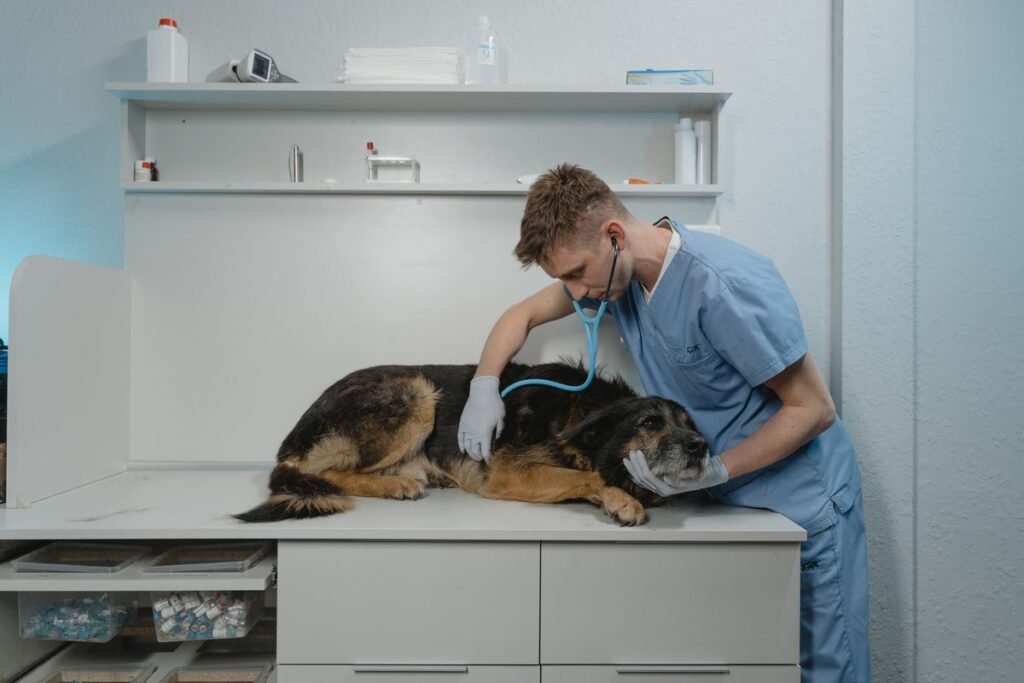
The test is a blood draw. The dog is brought to the clinic, a vet or a veterinary nurse takes a blood sample, usually from a vein in the leg or the neck, and the sample is tested for relaxin. The amount of blood needed is small, and the dog does not need to fast, and there is no sedation and no preparation at home. The whole appointment takes a few minutes, and the dog goes home straight after.
There are two kinds of test, and the difference matters for how long you wait. The first is an in clinic test kit, a test cassette that gives a result in about 10 to 20 minutes. The second is a laboratory test, where the sample is sent to a laboratory and the result comes back in a day or two. The in clinic kit is faster, and the laboratory test is more precise. Your vet will tell you which one the clinic uses, and the laboratory test is the better choice if the result matters for a breeding decision, because a laboratory result is more likely to be read the same way by a different vet.
The blood test detects relaxin with an immunoassay. The sample is exposed to antibodies that bind to relaxin, and the amount of binding tells the test whether relaxin is present above a threshold. The test does not give a number you can read off a chart: it gives a yes or a no, and the yes or no is read against a threshold that the kit maker sets. That threshold is the reason the test has a window, and it is the reason a small litter can give a negative result even when the dog is pregnant, because a litter of one or two puppies makes less relaxin than a litter of six.
If the sample is no good, the vet will say so and take a fresh one. A sample that is too small, or that has been left too long, or that has been damaged in handling, can give a wrong result, and a vet would rather take a fresh sample than read a doubtful one.
When to test: the day 28 rule and the testing windows
The best day to test is day 28 after mating, when relaxin is reliably detectable. Testing before day 22 is unlikely to give a useful answer, because relaxin may not yet be detectable. Testing between day 22 and day 27 can give a positive, but a negative in that window does not rule out pregnancy, and the test should be repeated one week later. Testing from day 28 onwards gives the most reliable result, and two consecutive negative tests one week apart confirm that the dog is not pregnant. In rare cases a third test is done at days 31 to 34 after breeding.
Those windows come from the sources and not from a single study, and the sources count from different starting points. The Merck manual gives 20 to 25 days after fertilisation, VCA Hospitals gives 22 to 27 days after breeding, the AKC gives 25 to 30 days after breeding, and the Merck owner manual gives 30 to 35 days. The safe way to use them is to count from the mating date and to treat day 28 as the dependable point, and the worked example in the relaxin accuracy guide puts the four windows on one calendar so you can see how far apart they fall.
The earliest reliable day for each confirmation method is in the vet confirmation timeline, and the blood test is the earliest of the four: the blood test from day 28, palpation at day 28 to 35, ultrasound from day 21 to 25 for a first look and more reliably after day 28, and X-ray from day 45. The blood test is the earliest, but it is not the most complete, and it is worth knowing what the later tests add.
What a positive result means
A positive result means the dog was pregnant at the time the blood was drawn. Placental tissue was present and producing relaxin, and that is a solid answer. It does not mean the puppies are alive, and it does not mean there will be a live birth, and it does not tell you how many puppies there are. It tells you that a pregnancy existed at the moment of the test, and nothing more. If the dog is still nursing from a previous litter, the positive may be measuring hormone left over from that litter, because relaxin can remain detectable for up to 50 days during lactation.
A positive result needs a follow up. The next step is usually an ultrasound, which shows whether the puppies are alive, and whether the pregnancy is developing normally, and the ultrasound week by week guide explains what the scan shows at each stage. A positive blood test and a clear ultrasound together are a strong answer, and a positive blood test on its own is a weaker one, because it cannot show heartbeats. If the ultrasound finds no puppies, the vet will look for the reason, and a false pregnancy is the first thing to check.
The false pregnancy guide explains what false pregnancy looks like, and the key point for the blood test is that a bitch in false pregnancy can test positive for relaxin, according to the Merck manual. A positive result in a dog showing false pregnancy signs needs an ultrasound to confirm, not another blood test. The blood test cannot tell a false pregnancy from a real one, because both make relaxin, and the difference is only visible on a scan.
What a negative result means
A negative result means relaxin was not detected in the blood at the level the test can read. That can mean the dog is not pregnant, or it can mean the test was done too early, the mating date was wrong, or the litter is too small to make enough hormone. VCA's rule is the one to follow: a single negative test before day 27 does not rule out pregnancy, the test should be repeated one week later, and two consecutive negative tests one week apart confirm that the dog is not pregnant. In rare cases a third test is done at days 31 to 34 after breeding.
The three causes of a false negative are timing, a wrong mating date, and a small litter. The most common is timing: the test was done before relaxin was detectable, and the fix is a retest, not a different test. The second is a wrong mating date: if the breeding happened later than the owner thought, the day count is wrong and the test was done earlier in the pregnancy than the calendar suggests, and the fix is to recount from the correct date and retest. The third is a small litter: VCA notes that small and toy breeds carrying only one or two puppies may not produce enough relaxin for a positive test, because less placental tissue means less hormone, and the fix is an ultrasound, which looks for the puppies themselves and does not depend on hormone levels.
If the retest is also negative, the dog is not pregnant, and the owner can stop worrying about a due date and start planning the next season. If the retest is positive, the first result was a false negative, and the dog is pregnant, and the due date should be counted from the ovulation or mating record, with gestation at about 63 days from ovulation for all breeds. The how to calculate guide works through the counting method.
In clinic kit or laboratory test: which is better
An in clinic test kit gives a result in 10 to 20 minutes, and a laboratory test takes a day or two, and the difference is a trade off between speed and precision. The in clinic kit is a test cassette, and it gives a yes or a no, and it is read by eye. The laboratory test is run on laboratory equipment, and it is read by a machine, and it gives a result that another vet can read the same way. Neither is more accurate as a test of whether relaxin is present, but the laboratory test is more precise as a reading, and the in clinic kit is more convenient as an appointment.
The choice matters when the result will be used for a decision. If the result is needed to decide whether to book a mating, or whether to plan a caesarean, or whether to buy a whelping box, the laboratory test is the better choice, because a laboratory result is easier to share with another vet and harder to argue with. If the result is needed to settle a question quickly, the in clinic kit is the better choice, because it gives an answer in the same appointment. Your vet will tell you which the clinic uses, and will say which is better for the decision you are making.
The cost difference is small, and the time difference is the real trade off. An in clinic kit is cheaper than a laboratory test, but the difference is not large, and the laboratory test is worth the extra day if the result matters. Ask the vet which the clinic uses, and what the result will look like, and whether a laboratory test would be better for the decision you are making.
What the blood test cannot tell you
The blood test cannot tell you how many puppies there are. Relaxin levels do not count puppies, and a higher level does not mean a bigger litter. The number of puppies is a question for an X-ray from day 45, when the foetal skeletons are visible, or for an ultrasound, which can give an estimate but not an exact count. The puppy count accuracy guide explains how accurate an X-ray count is and why it can be off by one or two.
The blood test cannot tell you the due date. The due date comes from the ovulation or mating record, with gestation at about 63 days from ovulation for all breeds, and the how to calculate guide works through the counting method. A calculator gives an estimate only. It never confirms a pregnancy, and it never takes the place of a blood test or a scan. To check the date you have, enter the mating or ovulation date in the dog due date calculator and note the full window, not just the central date.
The blood test cannot tell you whether the puppies are alive. Relaxin is made by the placenta, and a placenta can be present after the puppies have died, so a positive test does not prove a live birth. Only an ultrasound can show heartbeats, and the ultrasound week by week guide explains what the scan shows at each stage. The blood test is a yes or no about pregnancy, and it is not a check on the puppies themselves.
Why there is no home or urine test for dogs
There is no urine test for dogs, because dogs do not produce hCG, the hormone human urine tests detect, and relaxin circulates in the blood, not in the urine. A human pregnancy test dipped in dog urine will not work, at any stage, and the pregnancy test overview explains why in full. There is no home test either: no test you can buy and use at home will confirm a dog pregnancy, and no sign you can see at home is reliable in the first three weeks.
The signs owners look for in the first three weeks are not reliable. A dog can be pregnant and show no signs at all, and a dog can show signs and not be pregnant. Appetite, behaviour, nipple changes and tiredness all vary, and none of them is a test. The early signs guide explains what to look for and what not to read into it, and the blood test is the first reliable confirmation.
A home test that claims to work for dogs is either a human test repackaged, which will not work, or a kit that asks you to take a blood sample at home, which you should not do. Taking a blood sample at home is not safe for the dog, and a sample taken at home is not reliable for the test. The blood test needs a vet, and a vet visit is part of the test, not an extra.
Questions to ask your vet
Take these to the vet visit, with the mating dates written down. Ask what day of the pregnancy the dog is on by the clinic's count, and whether that day falls after day 28, when the test is most reliable. Ask whether the test will be run in the clinic or sent to a laboratory, and when to expect the result. Ask what a negative result would mean on this particular day, and when the retest should be booked if the first result is negative. Ask whether the dog's size and likely litter size affect the result, especially if she is a small or toy breed. Ask whether a positive result needs an ultrasound to confirm viability, and when that scan should be booked. Ask whether the dog is still nursing from a previous litter, and whether that could affect the result.
A calculator gives an estimate only. It never confirms a pregnancy, and it never takes the place of a blood test or a scan. To check the date you have, enter the mating or ovulation date in the dog due date calculator and note the full window, not just the central date. The how to calculate guide works through the counting method, and the accuracy guide explains how much weight to give each kind of result.
Frequently asked questions
How soon can a blood test detect pregnancy in dogs?
Relaxin is first detectable from about 20 to 25 days after fertilisation, according to the Merck manual, 22 to 27 days after breeding, according to VCA, and 25 to 30 days after breeding, according to the AKC. The dependable day is day 28 after mating, when relaxin levels are high enough to detect reliably. Testing before day 22 is unlikely to give a useful answer.
How accurate is a dog pregnancy blood test?
There is no published accuracy percentage for the relaxin test, and the only numbers in circulation come from kit makers and rival pages. The test is reliable when used correctly, which means testing on or after day 28 after mating, repeating a negative test one week later, and having a vet read the result in context. Percentages on rival pages, 80 percent and 98 percent, are unsourced claims, not measurements.
Does a dog pregnancy blood test show how many puppies there are?
No. Relaxin levels do not count puppies, and a higher level does not mean a bigger litter. The number of puppies is a question for an X-ray from day 45, when the foetal skeletons are visible, or for an ultrasound, which can give an estimate but not an exact count.
Can a blood test be wrong?
Yes. A negative result can be wrong if the test was done too early, the mating date was wrong, or the litter is too small to produce enough hormone. A positive result can be wrong in a pseudopregnant bitch, or in a bitch still carrying relaxin from a previous pregnancy or a recent season. The retest rule and an ultrasound are the ways to check a result that does not match what you expected.
When should I retest after a negative result?
A single negative test before day 27 does not rule out pregnancy, and the test should be repeated one week later. Two consecutive negative tests one week apart confirm that the dog is not pregnant. In rare cases a third test is done at days 31 to 34 after breeding. If the vet still suspects pregnancy after two negatives, an ultrasound is the next step.
Can I do a dog pregnancy test at home?
No. There is no home test for dogs. A human pregnancy test will not work, because dogs do not produce hCG, and relaxin circulates in the blood, not in the urine. A blood sample has to be taken by a vet, and a home blood sample is not safe for the dog and not reliable for the test.
Sources
- VCA Hospitals, "Pregnancy Testing in the Dog." https://vcahospitals.com/know-your-pet/pregnancy-testing-in-the-dog — The source for the blood test method, the day 22 to 27 window, the retest rule and the false negative causes.
- Merck Veterinary Manual, "Serologic Test Kits." https://www.merckvetmanual.com/clinical-pathology-and-procedures/diagnostic-procedures-for-the-private-practice-laboratory/serologic-test-kits — The source for the day 20 to 25 window and for relaxin as a reliable indicator of pregnancy.
- AKC, "Dog Pregnancy: Signs, Care, and Preparing for Puppies." https://www.akc.org/expert-advice/health/dog-pregnancy-care-prep/ — The source for the day 25 to 30 window and for the 15 to 18 day implantation window.
- Merck Veterinary Manual, "Management of Reproduction in Dogs." https://www.merckvetmanual.com/dog-owners/reproductive-disorders-of-dogs/management-of-reproduction-in-dogs?query=reproductive — The source for the day 25 to 30, day 30 to 35 and day 55 to 60 windows; states relaxin is not detectable by 7 days after whelping.
- Merck Veterinary Manual, "Canine Pregnancy Diagnosis." https://www.merckvetmanual.com/reproductive-system/reproductive-diseases-of-the-female-small-animal/canine-pregnancy-diagnosis — States ultrasound is the preferred pregnancy test and X-ray from day 45 can identify foetal skeletons; describes the day 28 to 35 palpation window.
- VCA Hospitals, "False Pregnancy in Dogs." https://vcahospitals.com/know-your-pet/false-pregnancy-in-dogs — The source for false pregnancy as a cause of a positive test; relaxin can still be detected 5 to 7 weeks after the season.
- VCA Hospitals, "Breeding for Pet Owners: Whelping." https://vcahospitals.com/know-your-pet/breeding-for-pet-owners-whelping — The source for the day 21 to 25 ultrasound window and the day 45 X-ray window.
Where sources disagree, the disagreement is stated in the article rather than picking one figure silently: the relaxin detection window is 20 to 25 days after fertilisation (Merck), 22 to 27 days after breeding (VCA), 25 to 30 days (AKC) and 30 to 35 days (Merck owner manual), and the anchors differ; no authoritative source opened gives a sensitivity or specificity percentage for the relaxin test.
Disclaimer
This article is general information only. It cannot tell you whether a dog is pregnant, diagnose any condition, or stand in for veterinary advice. Calculator results on this site are estimates. If you think your dog may be pregnant, or if anything in this guide worries you, speak to your veterinarian.
Keep reading

My Dog Is Pregnant: What Do I Do Now
Your dog is pregnant and it was not planned. Start here: confirm it, book the vet, work out the due date, and…

Dog Pregnancy Preparation Guide Before Due Date
Get ready before the due date in three waves: the vet plan and puppy count, the room and whelping box, and the…

How to Care for a Pregnant Dog for the First Time
Your dog is pregnant for the first time, and you have never done this before. Start with confirmation and a vet plan,…