Pregnant Dog Vet Visit Schedule: When to Book Each Visit
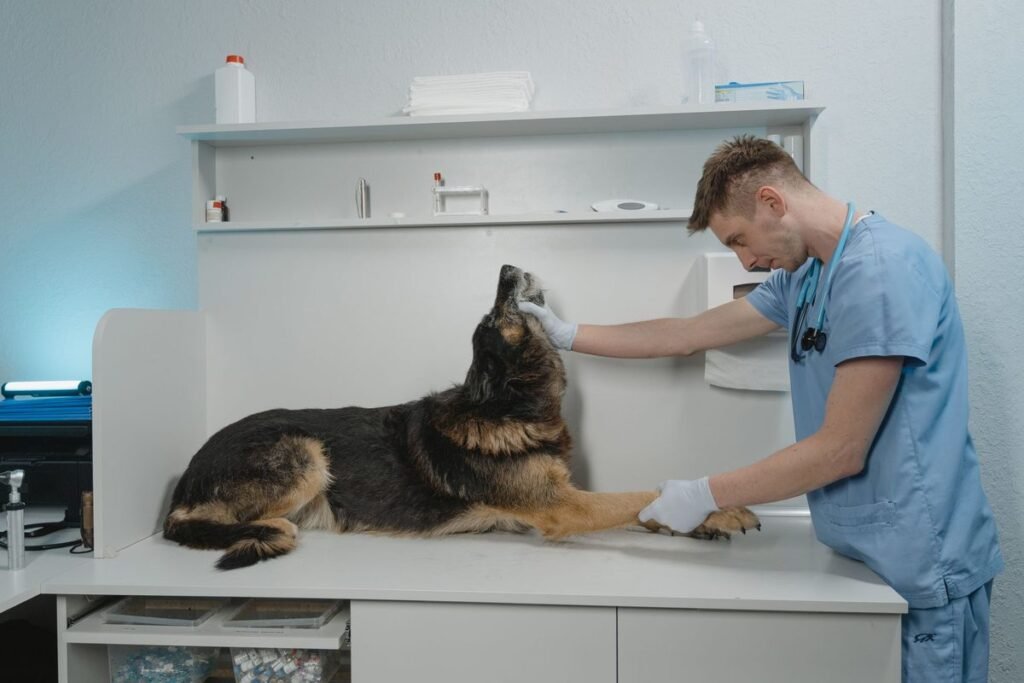
A pregnant dog vet visit schedule is a short plan, not a long one. Most healthy pregnancies need only a few vet visits: one early visit to set the plan, one confirmation visit in week 4, one late X-ray visit after day 55 for the puppy count, and one pre-whelping check in the final days. The exact dates depend on how the pregnancy was dated, so this article gives you the schedule two ways: counted forward from the mating date, and counted back from the due date.
The reason the schedule matters is timing. Every pregnancy test has a window when it works, and the windows do not overlap much. An ultrasound booked too early can miss the pregnancy. An X-ray booked too early cannot count the puppies. A pre-whelping check booked after labour starts is too late to change the plan. Book each visit inside its window and the vet gets a useful answer from every trip.
This article is about the when, not the how. For what each test shows and what it cannot do, see our guides to the dog pregnancy ultrasound, the ultrasound timing and the dog pregnancy X-ray. Those articles explain the tests. This one tells you when to book them.
Pregnant dog vet visit schedule: the schedule at a glance
Count the days from the mating date. If your dog was mated on more than one day, count from the first mating date for the earliest possible day and from the last mating date for the latest, and keep both dates in mind when you book. If the mating date is unknown, the day counts below cannot be applied directly, and your vet will date the pregnancy from what the scan shows instead.
| Visit | When | What it is for |
|---|---|---|
| Visit 1: first vet visit | As soon as you suspect pregnancy, weeks 1 to 3 | Set the plan, agree the due date and the emergency plan |
| Visit 2: confirmation visit | Days 25 to 35, best booked at days 28 to 30 | Confirm pregnancy by ultrasound, blood test or palpation |
| Repeat visit, only if needed | One week after a negative early test | Repeat the test that came back too early to trust |
| Visit 3: late X-ray visit | After day 55 | Count the puppies and check their size and position |
| Visit 4: pre-whelping check | Final days, days 58 to 63 | Final check before whelping and a settled delivery plan |
That is four planned visits for a healthy pregnancy, plus a repeat visit only if an early test was inconclusive. Your vet may add a visit or move one, especially for a first litter, a very small or very large litter, or a breed with a known delivery risk. The schedule below is the starting point for that conversation, not a replacement for it.
How the dates in this schedule are counted
Day counts in this article are counted from the mating date, in the same way the sources count them. The mating day is day 0, so day 25 is 25 days after the mating date. This matches the counting used in our ultrasound timing guide, so the two articles agree with each other.
Two facts about dating shape the whole schedule. First, gestation is about 63 days from ovulation for all breeds, and about 62 to 64 days according to the Merck Veterinary Manual, but the date of breeding does not always match the date of conception. Sperm can survive for days in the bitch and eggs need 2 to 3 days after ovulation to mature, so the same pregnancy can be counted as 58 to 72 days from the first mating. That is why the schedule below is given in day ranges, not single days, and why the due date itself is an estimate.
Second, a vet-timed ovulation date gives a much tighter due date than a mating date. Cornell puts the due date at 63 days from ovulation, plus or minus 1 to 2 days, while a mating date gives a window of 63 days plus or minus 7 days from the first breeding. If your vet timed ovulation, use the ovulation date as your anchor and ask your vet to convert the day counts below to it. The visit order stays the same; only the calendar dates tighten up.
To get your due date before you build the schedule, use our dog due date calculator. It gives an estimated due date from the mating date. It cannot confirm pregnancy and it does not replace a vet visit, but it gives you the anchor date every visit below is counted from. Our guide to how to calculate a dog's due date explains the calculation in full, including how the window changes when you count from ovulation or the LH surge instead of mating.
Visit 1: the first vet visit, weeks 1 to 3
Book the first visit as soon as you suspect your dog is pregnant. Do not wait for a test to work before calling the vet. In the first three weeks no pregnancy test is reliable yet, so this visit is not about confirmation. It is about setting up the pregnancy properly.
The AKC advises taking your dog to the vet for a checkup if you think she may be pregnant, to rule out other conditions that can look like pregnancy and to discuss the plan. The AKC lists what regular vet visits through pregnancy let you discuss: expected due dates, litter size estimates, potential delivery complications, whether a planned caesarean may be advisable, and emergency care plans. The first visit is the right time to start that list, because the answers shape the later visits. A dog whose breed or history points toward a planned caesarean, for example, needs her later visits timed more tightly than a dog with no known risk.
Bring the dates to this visit: the mating date or dates, the first day of her heat if you know it, and any ovulation or progesterone timing your vet already did. Also bring her vaccination and health history, and a note of any change you have seen in appetite, energy or behaviour. Your vet will examine her, weigh her, and tell you what to watch for between visits and when to call sooner than planned. If she was not examined before breeding, the AKC notes that dogs should receive a complete veterinary examination before breeding and be current on vaccinations, so mention that too.
One thing this visit will not do is confirm the pregnancy. The embryos are too small to see reliably in the first three weeks, and a negative test now would mean nothing. If your vet does test this early, treat any negative result as "too early to tell" and book the confirmation visit below rather than accepting it as an answer. Our guide to how soon you can tell if a dog is pregnant covers the early signs and why they are not proof on their own.
Visit 2: the confirmation visit, days 25 to 35
This is the visit most owners mean when they ask about a pregnant dog vet visit schedule. Book it for days 28 to 30 after mating if you can choose the day. That sits inside every test window at once, so your vet can use whichever test fits your dog.
The windows, as the sources give them, are:
- Relaxin blood test: positive in most dogs 22 to 27 days after breeding, according to VCA. The AKC puts the relaxin test at about 25 to 30 days of gestation. Merck gives day 30 to 35. The test confirms pregnancy but does not confirm that the puppies are alive, and a negative result before day 27 should be repeated a week later, according to VCA.
- Ultrasound: the AKC gives 25 to 35 days of gestation, and says it can usually detect fetal heartbeats. VCA notes that embryos can be detected as early as three weeks after breeding, and that most scans performed after day 28 are reliable. Merck says ultrasonography can reliably detect pregnancy by 25 to 35 days and confirms that the fetuses are alive.
- Palpation: the AKC gives about the 28 to 30 day mark, when the puppies feel like small fluid filled sacs. VCA puts the best time for palpation at 3 and a half to 5 weeks of pregnancy. Palpation cannot reliably tell whether the puppies are alive, and it should only be done by a vet.
Booked at days 28 to 30, all three windows are open. That is also why the ultrasound timing guide recommends the same days: a scan at day 28 to 30 gives a reliable answer at the earliest useful point. If you book earlier, at day 21 to 24, the scan can miss the pregnancy entirely, and you will need the repeat visit below. If you book later, at day 35, the tests still work, but palpation becomes less useful as the sacs lose their distinct shape after about a month, according to the AKC.
What this visit settles is whether she is pregnant and whether the puppies are alive. It does not settle how many puppies there are. Ultrasound can give an estimate of litter size, according to the AKC, but it cannot count reliably. Do not expect a firm puppy count from this visit, and do not plan the whelping on the ultrasound estimate alone. The count comes from the late X-ray in Visit 3. For the detail on what the scan shows, see when you can do an ultrasound on a pregnant dog and our dog pregnancy ultrasound guide.
If the result is a false pregnancy rather than a real one, this is the visit where that becomes clear. A relaxin test can distinguish true pregnancy from false pregnancy, because dogs with false pregnancy do not produce relaxin, according to VCA. Our guide to false pregnancy in dogs explains the signs that can look like pregnancy and why only a vet test settles the question.
The repeat visit: only if an early test was negative
Not every pregnancy needs a repeat visit. You need one only if a test was done too early and came back negative, or if the first result was unclear.
The rule comes from VCA: a dog with a negative relaxin result on a test done 22 to 27 days after breeding should be tested again one week later, and two consecutive negative tests one week apart confirm that a dog is not pregnant. Rarely, a third test may be needed at 31 to 34 days after breeding. The same logic applies to an early ultrasound: a negative scan before about day 25 can miss the pregnancy because the embryos are too small to see, and the vet will usually repeat the scan a week later rather than declare the dog not pregnant.
So if your confirmation visit was booked at days 28 to 30 and came back negative, a repeat a week later is the step that settles it. If your first test was booked at day 21 and came back negative, the repeat is not a setback, it is the plan working as it should. Book the repeat for seven days after the first test and do not book the late X-ray until the pregnancy is confirmed.
Small and toy breeds deserve a note here. VCA points out that small and toy breeds carrying only one or two puppies may not produce enough relaxin for a positive test, so your vet may use another method for them. That is a reason to repeat or switch tests, not a reason to test earlier.
Visit 3: the late X-ray visit, after day 55
Book the X-ray visit after day 55. This is the visit that answers the question the ultrasound could not: how many puppies are there.
Puppy skeletons first show on X-ray at about day 43 to 45, according to both VCA and Merck. But an X-ray at day 45 gives a picture, not a reliable count. The AKC says X-rays work best at 55 days or later, because the puppies' skeletal systems do not show up on an X-ray until then, and that an X-ray at this stage gives an accurate puppy count so you will know when your dog has finished delivering. Merck says X-rays taken more than 55 days into pregnancy are the best way to determine litter size. The AKC's FAQ puts it the same way: a late pregnancy X-ray is the most reliable way to determine litter size, and Merck identifies radiography after 55 days as the best method for counting puppies.
That is why the schedule has a gap between the confirmation visit and this one. There is no test in weeks 6 and 7 that adds a firm answer, so there is no routine visit to book there for a healthy pregnancy. If your vet wants a mid-pregnancy check in that gap, for example to reweigh your dog or to check on a concern raised at the confirmation visit, that is your vet's call for your dog, and it does not change the X-ray date. Do not move the X-ray earlier to fill the gap: a count taken at day 45 to 50 is less reliable than one taken after day 55, and a wrong count is worse than a late one, because the count is what tells you during whelping whether a puppy is still to come.
At this visit your vet can also check the puppies' size and position before whelping. That check is part of the delivery plan: if a puppy is too large to pass through the birth canal, the vet will discuss a planned caesarean, as the AKC notes. Bring the whelping plan questions to this visit rather than leaving them to the final days, so there is time to arrange help, an emergency vet number, and transport if needed. For the full detail on the X-ray itself, see our dog pregnancy X-ray guide and our guide to how many puppies your dog will have.
Visit 4: the pre-whelping check, days 58 to 63
Book the last planned visit in the final days before the due date, from about day 58 onward. By now the whelping box should be ready and the emergency plan should be written down, so this visit is a final check, not a planning session.
Your vet will check your dog's general condition, confirm the puppies' position if needed, and go over the delivery plan one last time: what normal labour looks like, when to call, and where to go if help is needed out of hours. The AKC lists the labour signs that need a vet call, including no sign of labour within 24 hours of a temperature drop, the first puppy not delivered within two hours of contractions beginning, more than two hours between puppies, strong contractions for an hour without a puppy, exhaustion, trembling or collapse, green discharge before the first puppy, and a retained placenta. Keep that list with the vet's phone number by the whelping box. Our guides to the signs of labor in dogs and dog temperature before labor cover what to watch for at home between this visit and the birth.
Temperature is the home check that pairs with this visit. A drop in rectal temperature usually precedes delivery by about 8 to 24 hours, according to Merck, and the AKC gives the same window, with temperature falling from the normal 100 to 102.5 degrees Fahrenheit to 99 degrees or lower. Cornell notes the same drop, below 99 degrees Fahrenheit, within 24 hours of giving birth. Start taking her temperature in the final days if your vet advises it, and call your vet if labour has not started within 24 hours of the drop. Do not use the temperature drop on its own to decide that everything is fine: it is one sign, and the vet call thresholds above still apply.
The most important threshold in this final stretch is the one for a pregnancy that runs long. Call your vet if there is no sign of whelping 64 days after the last mating, according to the AKC. That is the trigger, not day 72. Day 72 is only the far edge of the 58 to 72 day window counted from the first mating, and waiting for it would mean waiting past the point your vet needs to know. If your pregnancy was dated from ovulation or the LH surge instead, the equivalent trigger is sooner, because those clocks are tighter: Cornell gives the due date as 63 days from ovulation plus or minus 1 to 2 days. Ask your vet at this visit which day is your call day on the clock you are actually on, and write it down.
Worked example: the full schedule from one mating date
Say your dog was mated on Sunday 8 February 2026. Counting forward from that date, with the mating day as day 0, the schedule looks like this.
| Visit | Day | Date |
|---|---|---|
| First vet visit | As soon as pregnancy is suspected, weeks 1 to 3 | From 8 February 2026 |
| Relaxin test window opens | Day 22 | Monday 2 March 2026 |
| Ultrasound reliable from | Day 25 | Thursday 5 March 2026 |
| Confirmation visit, best days | Days 28 to 30 | Sunday 8 March to Tuesday 10 March 2026 |
| Palpation window ends | Day 35 | Sunday 15 March 2026 |
| X-ray skeletons first visible | Day 43 to 45 | Monday 23 March to Wednesday 25 March 2026 |
| Late X-ray visit, puppy count | After day 55 | From Saturday 4 April 2026 |
| Pre-whelping check | Days 58 to 63 | Tuesday 7 April to Sunday 12 April 2026 |
| Approximate due date, mating plus 63 days | Day 63 | Sunday 12 April 2026 |
| Call the vet if no sign of whelping | 64 days after the last mating | Monday 13 April 2026 |
All dates verified by calendar calculation from 8 February 2026. Note that the approximate due date here, 12 April 2026, is mating date plus 63 days. That is an estimate from the mating clock. If your vet timed ovulation, the due date is 63 days from ovulation plus or minus 1 to 2 days, according to Cornell, and it may fall a few days either side of the mating date estimate. Use the same visit order and the same day counts either way, anchored to the date your vet gives you.
To build the same table for your own dog, take her due date and count back: the late X-ray falls about 8 days before the due date, the confirmation visit falls about 33 to 35 days before it, and the first visit falls in the first three weeks after mating. Or count forward from the mating date using the day numbers in the table above. Our dog pregnancy week by week guide describes what is happening inside each of those weeks, if you want the development behind the dates.
What if you do not know the mating date?
If the mating date is unknown, because she was mated while roaming or mated over several days without a record, the day counts in this schedule cannot be applied directly. There is no day zero to count from.
In that case, book the first vet visit as soon as you suspect pregnancy and let the vet date it. The dog whelping countdown turns the vet's date into a dated job list. Cornell notes that a vet can perform ultrasound measurements of the puppies when they are about midway through gestation to estimate the due date, and VCA notes that repeat testing is especially important when the breeding dates are unknown. The vet's estimate from the scan then becomes the anchor for the later visits, including the late X-ray count. It will not be as precise as a date counted from a known mating or a vet-timed ovulation, but it is the best available method when no breeding date was recorded, and it is far better than guessing a date from her size or behaviour.
The same applies if she was mated on several days. Count from the first mating date for the earliest the tests can work, and from the last mating date for the latest the due date can fall and for the vet call threshold. The AKC's 64 day threshold is counted from the last mating, so a second mating date moves that trigger day, not just the due date.
Visits that are not on this schedule
A few things owners expect on a vet visit schedule do not belong on it, and leaving them off is deliberate.
There is no routine visit in weeks 6 and 7 for a healthy pregnancy, because no test in that window adds a firm answer. There is no X-ray before day 43, because the skeletons are not visible yet. There is no puppy count before day 55, because the count is not reliable until then. And there is no visit listed for after the birth in this schedule, because that is a different plan: the mother and puppies should be checked after whelping, and our guide to caring for a mother dog after giving birth covers what that check is for.
If your dog shows worrying signs at any point, do not wait for the next scheduled visit. Contact your vet sooner. The schedule is for a healthy pregnancy. A dog who stops eating for more than a day, has discharge that smells bad, seems in pain, or shows any of the labour warning signs listed above needs a vet call the same day, whatever the calendar says.
Your booking checklist
Book the confirmation visit first, because it has the tightest window. Days 28 to 30 after mating is the booking to make as soon as the first visit is done, and it is the one that is hardest to move later without losing the palpation window.
Then book the late X-ray for after day 55, and the pre-whelping check for the final days before the due date. Put the vet call day in your phone now: 64 days after the last mating if there is no sign of whelping. Keep the vet's number and the nearest emergency clinic's number by the whelping box, with the puppy count from the X-ray written beside them, so that during labour you know how many puppies to expect and who to call if the count does not match.
Four planned visits, one repeat visit only if an early test was inconclusive, and one phone number kept close. That is the whole schedule. The tests do the confirming and the counting; the schedule makes sure each test happens on a day when it can actually answer the question.
Disclaimer
This article is general information, not veterinary advice. Only a vet who examines your dog can confirm pregnancy, interpret a test, or advise on her care. The calculator gives an estimated due date; it cannot confirm pregnancy and does not replace veterinary diagnosis. If you are worried about your dog at any stage of pregnancy, contact your vet.
Frequently asked questions
How many vet visits does a pregnant dog need?
Most healthy pregnancies need four planned visits: a first visit as soon as pregnancy is suspected, a confirmation visit at days 28 to 30, a late X-ray visit after day 55, and a pre-whelping check in the final days. A repeat visit is needed only if an early test was negative or unclear. Your vet may add a visit for a first litter, a very small or large litter, or a breed with a known delivery risk.
When should I first take my pregnant dog to the vet?
As soon as you suspect she is pregnant, in weeks 1 to 3. Do not wait for a test to work. The first visit sets the plan, agrees the due date and the emergency plan, and rules out other conditions that can look like pregnancy. No pregnancy test is reliable in the first three weeks.
What is the best day to book the confirmation visit?
Days 28 to 30 after mating. That sits inside every test window at once: relaxin blood test, ultrasound and palpation. Ultrasound is reliable from about day 25 and most reliable after day 28, and palpation is best at about days 28 to 30. Booking at days 28 to 30 gives a reliable answer at the earliest useful point.
When should the X-ray be done to count the puppies?
After day 55. Puppy skeletons first show on X-ray at about day 43 to 45, but the count is not reliable until after day 55. An X-ray at day 45 gives a picture, not a firm count, and a wrong count is worse than a late one because the count tells you during whelping whether a puppy is still to come.
Does my dog need a vet visit just before whelping?
Yes, book a pre-whelping check from about day 58 onward, in the final days before the due date. Your vet checks your dog's condition, confirms the puppies' position if needed, and goes over the delivery plan one last time, including when to call and where to go for emergency help.
What if I do not know the mating date?
Book the first vet visit as soon as you suspect pregnancy and let the vet date it. Your vet can estimate the due date from ultrasound measurements of the puppies at about midway through gestation, and that estimate becomes the anchor for the later visits. Repeat testing is especially important when the breeding dates are unknown.
Sources
Keep reading

My Dog Is Pregnant: What Do I Do Now
Your dog is pregnant and it was not planned. Start here: confirm it, book the vet, work out the due date, and…

Dog Pregnancy Preparation Guide Before Due Date
Get ready before the due date in three waves: the vet plan and puppy count, the room and whelping box, and the…

How to Care for a Pregnant Dog for the First Time
Your dog is pregnant for the first time, and you have never done this before. Start with confirmation and a vet plan,…