9 Weeks Pregnant Dog: Final Days and Labour
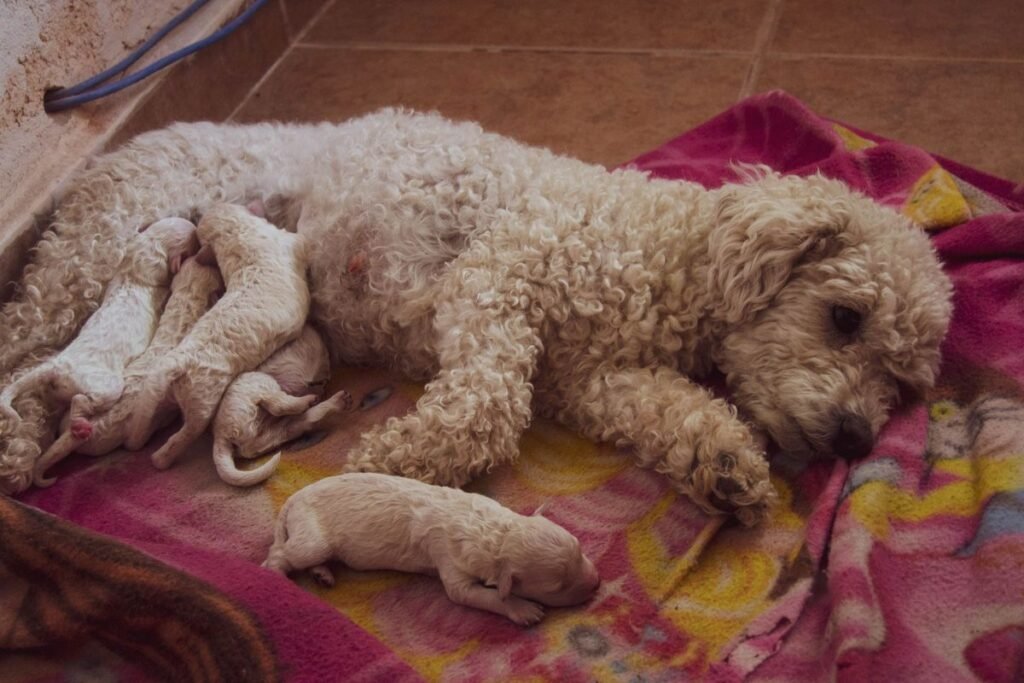
Your dog is 9 weeks pregnant. She is now on days 57 to 63 counted from the first mating, and whelping is not far away. This is the final stage of the pregnancy, and the focus now is on watching her closely, being ready for labour, and knowing when to call the vet. The birth usually happens on about day 63, but it can be a few days early or late. Use this week to stay calm, keep her comfortable, and be ready.
| Week 9 at a glance | |
|---|---|
| Days | 57 to 63 from the first mating |
| Puppies | Fully formed and ready to be born; they will usually arrive on about day 63 |
| Mother | Belly is large, milk should be present, nesting is strong, and her appetite may fall; her temperature will fall before labour |
| This week | Keep recording her temperature twice a day; watch for the drop to below 37.2 °C (99 °F); have the whelping box ready; have your vet's number close by |
How to count week 9
Week 9 is counted from the first day of mating, with day 1 being the day of the first mating. You need one plain, fixed way of counting it. The safest is to count from the first mating.
The puppies are ready to be born in a few days, and the birth usually happens on about day 63. Week 9 is often when owners are most worried: she is large, is moving more slowly, and may seem uncomfortable. This is normal.
Check the date: the dog due date calculator works from the first mating date or, for a tighter estimate, from the ovulation date. The result is an estimate only, not a confirmation of pregnancy, and not a substitute for veterinary advice. If a due date has already passed, see your vet.
What is happening with the puppies this week
By week 9 the puppies are fully formed. They are growing quickly and gaining weight. The organs are working and the puppies are ready for the outside world. They are starting to move around more and are more active than they were last week. You may be able to see them moving under her skin. Their skeletons should now show clearly on an X-ray.
If you are counting from the first mating, the puppies are at about day 57 to 63. If you know the ovulation date — or you used a dog ovulation calculator or a dog progesterone calculator to work out the ovulation date — use it for a tighter estimate. The puppies are ready to be born at about day 63.
What you may notice in your dog
Your dog's belly is now large and obvious. She may be moving more slowly and sleeping more. The mammary glands are full and may leak a little milk. She may also have a little clear discharge. Do not give her any medication unless the vet says it is safe.
You may also notice her appetite changing. Some dogs eat less at a time, but more often. She may not want to walk as far as before. She may be more clingy and want to be near you, or she may want to be on her own. Both are normal. If she is resting, let her rest.
You may see the puppies moving in her belly. If you place your hand gently on her belly, you may feel the puppies kicking. This is normal. The movement is stronger than it was last week.
The temperature drop before labour
The temperature drop is the most reliable sign that labour is near. From about day 55, take your dog's temperature twice a day and record it. Her normal temperature is about 38.3 to 39.2 °C (101.0 to 102.5 °F). A fall to below 37.2 °C (99 °F) usually means labour will start within the next 24 hours.
To take her temperature, use a digital thermometer. Apply a little lubricant, lift the tail, and insert the thermometer about 2.5 cm (1 inch). Hold it still for about a minute. If it beeps, remove it, read the number, and record it. If the number is below 37.2 °C (99 °F) at two checks, labour is likely to start within 24 hours.
If you are not comfortable taking her temperature, ask your vet to show you. Even a single check can show whether labour is close. Keep a record, so you can see the change when it comes.
If your dog shows a temperature above 39.2 °C (102.5 °F), or if it stays low for more than 24 hours, contact your vet. A high temperature can be a sign of infection, and a low temperature that does not lead to labour can be a sign of a problem.
The first signs of labour
The first signs of labour are restlessness, panting, pacing, and nesting. Your dog may dig, scratch, and rearrange her bedding. She may go off her food, vomit, or have loose faeces. These signs are normal. She may also become more clingy, or she may want to be alone. The first stage of labour can last from 6 to 12 hours, but it can be longer for a first litter.
If your dog is in the first stage, leave her alone and let her settle. Do not try to help her. She will know what to do. If you are worried, call your vet.
Stage 1: early labour
Stage 1 is the early stage of labour. Your dog may be restless, pant, pace, and refuse food. She will start to have contractions, but they are mild at first. You may notice a clear discharge from the vulva. The cervix is opening, and the puppies are moving into position. Stage 1 usually lasts 6 to 12 hours, but it can be longer for a first litter.
Stage 2: the birth of the puppies
Stage 2 is the birth of the puppies. Your dog will start to push. A puppy should be born within 30 minutes of strong straining. Puppies are usually born 30 minutes to 2 hours apart, but there can be longer gaps. If your dog strains hard for more than 30 minutes with no puppy, call the vet.
After the puppy is born, the mother will lick it and bite the cord. If she does not, you may need to help. Do not pull the cord. Use clean scissors to cut it, and tie it with thread or dental floss. If the puppy is not breathing, rub it gently with a towel and clear its nose and mouth with a bulb syringe.
Stage 3: delivering the placentas
Stage 3 is when the placenta is delivered. Each puppy is followed by a placenta, and you should try to count them to make sure none are left inside. If your dog is still straining after the last puppy is born, call your vet. A retained placenta can cause infection.
Once all the puppies are born, your dog should be calm and settled. Give her water to drink. If she is bleeding heavily, call the vet straight away.
How long does dog labour last?
Labour time varies between dogs. For most dogs, the whole process takes 6 to 12 hours. Some breeds take longer. If labour goes on for more than 24 hours, or if there is a gap of more than 2 hours between puppies, call the vet. The number of puppies affects the length of the labour: more puppies mean a longer labour. The first litter often takes longer than the next ones.
When to call the vet (red flags)
Call your vet straight away if you see any of the following: strong straining for more than 30 minutes with no puppy, or a gap of more than 2 hours between puppies; a foul smelling discharge; heavy bleeding; the dog seems in pain; a puppy is stuck in the birth canal; the dog is not responding; labours ends but you are not sure all puppies are born; or you are worried for any reason. Do not wait and see.
Write down the time each puppy is born, and the time of the placenta delivery. This record can help the vet if they need to advise you.
What to have ready: the final check
Before labour starts, make sure the whelping box is clean, warm, and in a quiet place. Have clean towels, newspapers, a bulb syringe, a thermometer, a vet's number and the emergency clinic number, warm water, and a clean, dry towel for drying the puppies. Keep the room warm (about 22 °C to 25 °C, or 72 °F to 77 °F). Have a whelping record ready to write in.
Keep your vet's number and the emergency clinic number where you can see them. If you think there is a problem, call straight away. Use the whelping calculator to plan the due date and to get a checklist for what you will need.
Your week 9 checklist
- Record her temperature twice a day and write it down
- Have the whelping box ready with clean bedding and warm towels
- Keep your vet's number and the emergency clinic number where everyone can see them
- Keep walks short and gentle and keep her rested
- Feed small, frequent meals and keep fresh water close by
- Watch for nesting behaviour and leave her alone if she is making a nest
Related guides
Frequently asked questions
When will my dog give birth?
She is usually due on about day 63 counted from the first mating. Week 9 covers days 57 to 63. A few days early or late can be normal, but confirm the date with your vet.
What are the first signs of labour in a dog?
Restlessness, panting, pacing, nesting, and going off food are the first signs. Her temperature falls to below 37.2 °C (99 °F) in the day before labour starts. These signs mean labour is close.
My dog is 9 weeks pregnant but has not given birth yet. What now?
If she is over day 63, contact your vet straight away. The due date is an estimate. Confirm the date with a scan, and your vet can tell you whether the puppies are in position.
How long does dog labour last?
Labour usually lasts 6 to 12 hours, but it can be longer for the first litter. If the process goes on for more than 24 hours, or if there is a gap of more than 2 hours between puppies, call the vet.
What should I do if a puppy is born and not breathing?
Rub the puppy gently with a clean towel, clear its nose and mouth with a bulb syringe, and hold it face down for a few seconds to help fluid drain. If it does not breathe, call the vet.
When should I call the vet during labour?
Call the vet if your dog strains hard for more than 30 minutes with no puppy, if there is a gap of more than 2 hours between puppies, if there is heavy bleeding or a foul smelling discharge, or if you are worried for any reason.
Do dogs need human help to give birth?
Most dogs can give birth without help. You should watch from a distance and let her get on with it. Be ready to help if she needs it, and call the vet if you are worried.
Sources
- American Kennel Club, Dog Pregnancy: Signs, Care, and Preparing for Puppies — https://www.akc.org/expert-advice/health/dog-pregnancy-care-prep/
- AKC — Dog Pregnancy Signs, Symptoms, and Stages: https://www.akc.org/expert-advice/dog-breeding/dog-pregnancy-signs-symptoms-stages/
- AKC — Whelping Checklist: What to Get Ready for the Whelping of Your Dog: https://www.akc.org/expert-advice/dog-breeding/whelping-checklist/
- Cornell — Reproductive Cycle of Dogs: https://www.vet.cornell.edu/departments-centers-and-institutes/riney-canine-health-center/canine-health-topics/reproductive-cycle-dogs
- VCA — Breeding for Dog Owners: https://vcahospitals.com/know-your-pet/breeding-for-dog-owners-care-of-the-pregnant-dog
- RSPCA — Dog Pregnancy: https://www.rspca.org.uk/adviceandwelfare/pets/dogs/health/pregnancy
- The Kennel Club — Breeding from your dog: https://www.thekennelclub.org.uk/breeding/breeding-from-your-dog/
Disclaimer
This article is general information only. It does not confirm that a dog is pregnant, diagnose any condition, or replace veterinary advice. Calculator results on this site are estimates, and every pregnancy is different. If you think your dog may be pregnant, if you are worried about her, or if anything in this guide concerns you, contact your veterinarian.
Keep reading

My Dog Is Pregnant: What Do I Do Now
Your dog is pregnant and it was not planned. Start here: confirm it, book the vet, work out the due date, and…

Dog Pregnancy Preparation Guide Before Due Date
Get ready before the due date in three waves: the vet plan and puppy count, the room and whelping box, and the…

How to Care for a Pregnant Dog for the First Time
Your dog is pregnant for the first time, and you have never done this before. Start with confirmation and a vet plan,…